
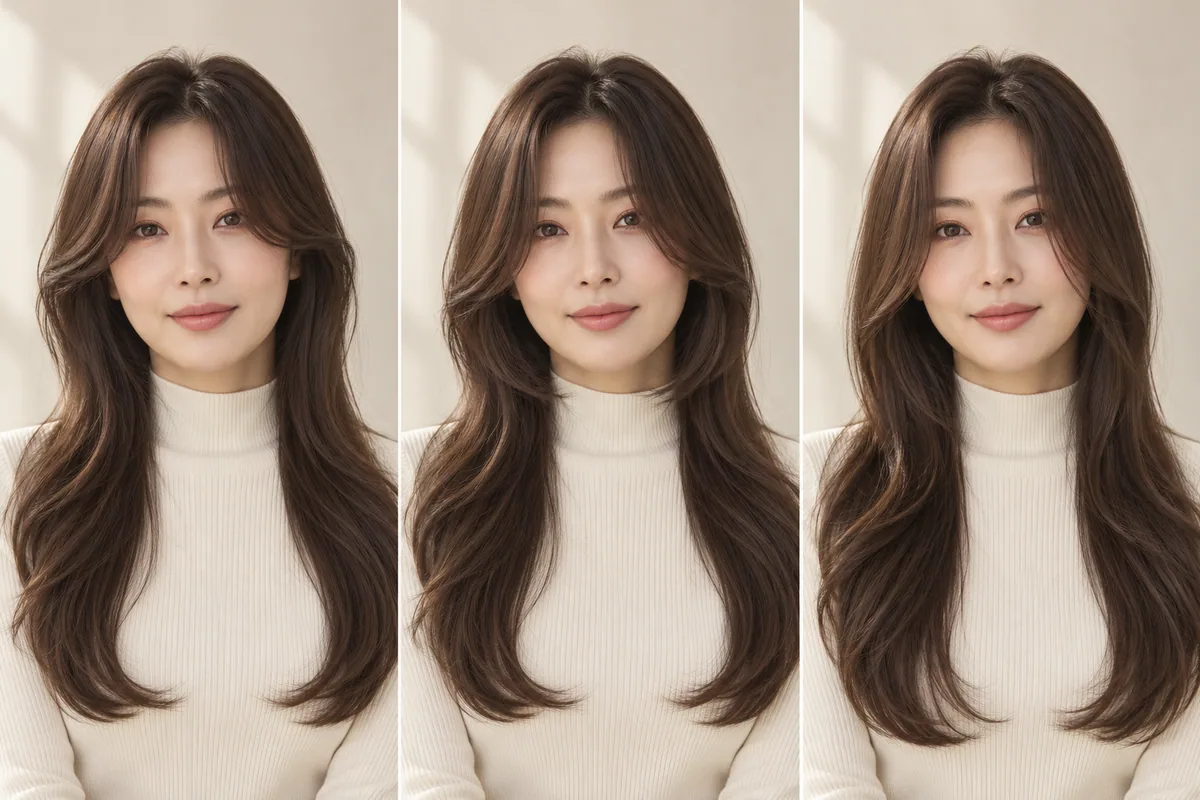
Long curtain bangs leave a parted opening at the front and extend outward into longer pieces beside the face. “Long” is not one measurement: references can place the shortest visible pieces near the cheek, jaw or chin. Choose the endpoint and amount of forehead coverage you want before relying on the label.
This guide is about length within a parted fringe. If your question is whether you want bangs at all, begin with bangs versus face-framing layers. Here, the useful decision is where the chosen front shape should sit.
Start with a landmark on your own face
Look at the shortest piece in each reference, not the longest side strand. Is it visible near the cheekbone? Does it reach toward the jaw? Is most of the front closer to chin length or below? Follow the actual edge rather than the curve created by styling.
In Modern Salon's fringe demonstration, one curtain-fringe example reaches around the chin. It is a useful reminder that the term includes longer interpretations; it is not a universal length instruction.
On a photo of yourself, mark the point you would like the shortest visible front section to reach. The mark is a conversation starter. Your stylist should decide how to translate it to the actual hair, particularly if you are comparing a styled or waved reference.
Do not let the longest strand answer the question
Many fringe references show long pieces flowing into the rest of the haircut. Those pieces can distract from a much shorter center section. Trace the front from the part outward. Where does the first clearly shorter section begin and end?
This matters if you are choosing a longer fringe because you want fewer pieces near your eyes. A photograph can look long overall and still contain a short central feature that you would notice every morning.
Ask the stylist to identify the shortest proposed piece. Then discuss the connection into the longer side hair. You want to understand both parts before the cutting plan is agreed.
Compare cheek, jaw and chin directions
Use the landmarks as visual categories, not promises about comfort or maintenance.
On a small screen, swipe the table to compare every column.
| Reference direction | What to inspect | What remains to be checked |
|---|---|---|
| Near the cheek | The central opening and outward sweep | How the pieces would sit near your eyes and glasses |
| Around the jaw | The frame beside the face and connection downward | Which front sections would move forward in your normal part |
| Near the chin or longer | Whether the front reads as fringe or a longer side frame | Tucking, tie-back reach and the shape you actually want visible |
A longer endpoint may be appealing because it makes a quieter change. You may also prefer a shorter, more visible frame. Neither choice needs a face-shape rule to justify it. Choose what you enjoy seeing, then assess the practical details with a stylist.
Decide how wide the opening should feel
Length alone does not explain the appearance of curtain bangs. Two fringes with similar endpoints can leave different amounts of forehead visible. One may separate into a wide opening; another may sweep inward before turning outward.
Try drawing an outline around the open space in each reference. Do you want a small opening, more visible forehead or an off-center arrangement? Notice whether your preference stays the same when the longer hair is pulled away from the face.
If you normally wear a side part, bring that version into the comparison early. The side-part curtain-bangs guide addresses the way the two sides can look different without forcing a center part onto your routine.
Check the glasses, tuck and tie-back questions in person
Wear your everyday glasses when you review the references. Look at where the front pieces meet the top rim and temples. You may want the brows visible, the side frame separated from the glasses or the hair simply clear of the parts you touch frequently.
Next, show the stylist how you tuck or secure the front. A photograph cannot prove that a piece will reach behind your ear or into a particular hair tie. The intended length, the path it travels and the actual cut all matter.
If you need a complete ponytail for work or exercise, show the position you use. The ponytail-length haircut guide explains why “long enough” is a practical demonstration rather than a number taken from somebody else's picture.
Distinguish the cut from the arranged curve
Long curtain bangs are often photographed with a noticeable outward bend. Decide whether that curve is a finish you enjoy creating or only part of the reference's appeal. A haircut name does not tell you how your own front pieces will sit without that arranging.
Find a second reference with a less styled finish. If the two pictures tell different stories, ask the stylist which elements could belong in your ordinary-day plan. Explain what you do now, including when you use heat, clips or a separate fringe routine.
The curtain-bangs routine article is useful if you want to discuss a lighter styling commitment. Avoid treating a longer fringe as an automatic guarantee of no work.
Explore a fringe direction on your photo
In Hair Magic, start with a clear photo and choose a hairstyle with supported fringe or front-detail choices. Try the available length and parting directions closest to your reference. Controls vary by style, so the app may not provide each landmark as a named setting.
Keep the rest of the hair similar while you compare. A simultaneous color change or dramatic new cut can make it harder to judge the front. Follow the bangs-filter guide if you need the basic workflow.
Tap Generate when ready. Your photo is uploaded for cloud processing and internet is required. Compare the preview beside the original. Look at the center opening, the point beside the cheek and the connection near the jaw.
The result is a visual estimate. It cannot test whether the hair will tuck, predict a cowlick or establish the way a fringe will fall through the day. If the useful feature is the endpoint, save the image with a note about that feature rather than accepting the entire generated finish.
Hair Magic is free to download with in-app purchases. Check the current preview access shown in the app. A good reference image is one that makes your request clearer, even when it is not a complete haircut plan.
A length-first salon brief
Bring one preferred reference and one boundary reference. The first shows the front you want. The second shows a length or amount of coverage you would rather avoid. Write the reason beside each.
A fictional brief might read: “I like an open center with the shortest visible front pieces around my jaw. This second picture is shorter near the eyes than I want. Please show me which pieces would change and check whether I could still secure them this way.”
Organize your chosen style and practical notes in a Salon Card. When you and the stylist agree on the shortest point, the opening and the connection to the sides, “long curtain bangs” becomes a much more useful request.
About this guidance. Published by Hair Magic, the app discussed here. Product details are based on the Hair Magic App Store listing, checked on 1 November 2026. This is planning guidance, not a professional assessment of your hair. AI previews are visual estimates; features and prices may change.
Read our editorial approach or explore all journal articles.