
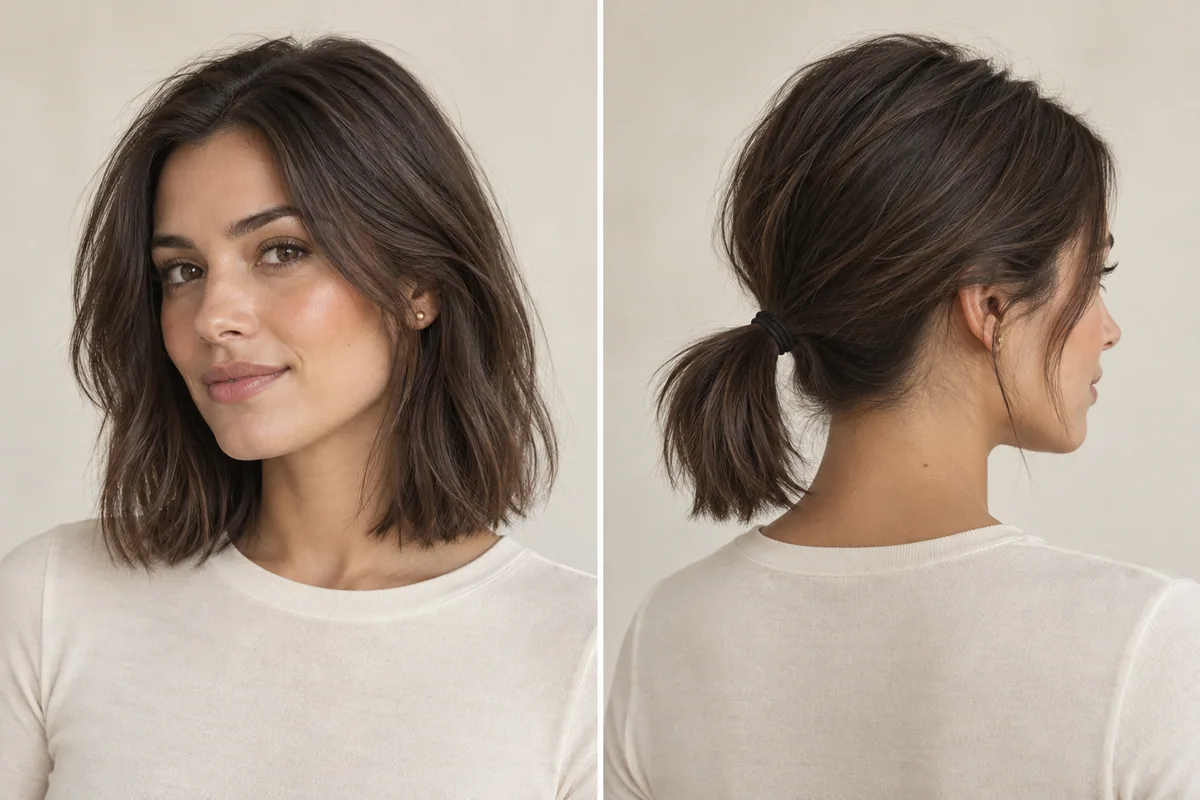
The shortest haircut that can go in a ponytail is the one that leaves your required sections long enough to reach your actual tie position. There is no reliable minimum in inches for everyone. A long bob may be a useful starting point, but the word “lob” alone does not promise that the front, sides and nape will all stay secured.
Before choosing the cut, decide what kind of ponytail you need. A small low tie with loose face framing is one brief. A secure high ponytail with every front piece contained is another. You can make that difference clear at the salon without knowing a single haircutting term.
Show the ponytail, not just a picture of the haircut
Bring the elastic you normally use. Arrive with your hair in a state close to how you usually wear it, and demonstrate the tie position during the consultation. Do not pull harder than normal to make marginal sections reach. The stylist needs to see the arrangement you will actually repeat at home.
Check the front, both sides and the nape. A ponytail can look complete from one angle while short pieces remain loose elsewhere. If those pieces would annoy you during work or exercise, say so before considering a shorter perimeter or new layers.
Professional styling examples also distinguish between low, high and half-up arrangements. Hair.com's short hairstyle guide includes both a half-up ponytail and a low gathering at the nape. Those are useful alternatives to show a stylist, but the examples do not establish a minimum cut length for your own hair.
Low, high or half-up: make the requirement explicit
Moving the elastic changes the direction each section travels. Test the position you care about instead of assuming that reaching one point means the hair will reach all of them. A half-up style deliberately leaves some hair down, which may or may not meet your reason for tying it back.
On a small screen, swipe the table to compare every column.
| The ponytail you need | What to demonstrate | What would count as a compromise? |
|---|---|---|
| A low tie at the nape | Gather the front and side sections into your usual low position | Pins beside the face, or a shorter tail than you wanted |
| A higher ponytail | Show the exact height, including the nape sections | Lowering the tie or leaving shorter nape pieces loose |
| All hair secured for work | Show the whole head from front, side and back | Any loose pieces your work requirements do not allow |
| A casual tie with face framing | Point out which pieces can stay out intentionally | More loose hair than you are comfortable adjusting |
| A half-up option | Separate the portion you actually want off your face | Hair remaining against your neck, if that is what you wanted to avoid |
Your acceptable compromise matters as much as the haircut name. If two small clips are fine, say so. If carrying extra accessories is exactly what you are trying to avoid, make that equally clear.
Overall length and shortest layers are separate choices
A haircut can retain a reasonably long lower edge while adding front pieces that no longer reach the elastic. That is why “leave enough length for a ponytail” is incomplete when the same appointment also includes face framing or layers.
Ask the stylist to identify the proposed shortest pieces. Point to the hair around your temples and the sections just above your ears if these are the ones you most need contained. Then ask about the back. A nice long tail does not compensate for nape hair that falls out if your goal is to keep your neck clear.
If you are choosing between a bob and a lob, our bob versus lob comparison covers the hair-down differences. Use the ponytail requirement to narrow those options before deciding which outline you prefer. For a bigger change, the long hair to short hair guide helps separate the features you want to lose from the habits you want to keep.
A five-minute consultation worksheet
Copy these prompts into your notes and fill them in before your appointment. The completed answers are more useful than a universal length chart.
On a small screen, swipe the table to compare every column.
| Prompt | Your note |
|---|---|
| Where is my elastic? | At the nape, mid-back of the head, or the specific higher position I will demonstrate |
| Which hair must stay secured? | Front, sides, nape, or all of it |
| What can stay loose? | Name the exact front pieces, or write “none” |
| What accessories will I use? | My usual elastic; optional clips only if I actually want them |
| How do I normally wear my texture? | My ordinary dry finish, rather than a special salon blowout |
| What is more important if the goals conflict? | The shorter hair-down outline, or keeping this particular ponytail |
Take current front, side and back photos of the tie as well. You do not need to publish them or upload them to an app. They are a record of what “still goes in a ponytail” means to you, especially if the appointment begins with your hair down.
For waves and curls, demonstrate with your usual texture rather than stretching everything into a shape you do not normally wear. Let the stylist assess the required length in person. A flat measurement or a generated image cannot establish how the finished hair will gather.
Three worked haircut requests
These are fictional scenarios for writing a clearer brief, not before-and-after claims.
You want a shorter outline but only tie back occasionally. “I would like the ends nearer my collarbone. A small low ponytail is enough for me, and I am happy to clip these two front sections. Please show me which other pieces might come loose before we decide on layers.” This leaves room for a shorter choice because you have defined an acceptable backup.
You tie back every day and want no extra steps. “This ponytail is how I wear my hair for work. Every section needs to stay in the elastic without extra pins. I would like it shorter, but keeping this arrangement matters more. Please assess the shortest workable length before we choose the haircut.” Here the practical requirement sets the limit.
You like short face framing but do not want hair near your eyes. “I like the shape in this picture, but I do not want to tuck those pieces constantly. Can we keep the front long enough to reach my tie and change the outline elsewhere?” You may find that a different detail delivers enough change without giving up the routine you rely on.
What an AI preview can help you decide
Hair Magic can help you explore how a supported bob or shorter style looks around your face when worn down. Choose a clear photo, browse the available shorter styles, and keep the color steady so the length is easier to compare. Adjust length, layers or parting only where the selected style supports those details.
When you tap Generate, the photo uploads for cloud processing and an internet connection is required. Review the result beside your original. The short hair try-on guide explains how to compare the silhouette without treating every generated strand as a prediction.
Even an attractive ponytail image cannot prove that your proposed cut will reach, grip securely or feel comfortable. The illustration at the top of this page is also an imagined editorial example, not a demonstration on real cut hair. Keep the physical tie check separate from the visual preview.
Favorite the hair-down direction you like and organize its details with a Salon Card. Add your completed worksheet alongside it. Hair Magic is free to download, with in-app purchases; review preview access in the app rather than assuming unlimited free generations.
At the appointment, ask for one last check before cutting: “Can you show me which sections will still reach this tie position?” If the answer requires a longer cut than your favorite picture, you can decide with the tradeoff visible. That is far better than discovering it the next morning with an elastic in your hand.
About this guidance. Published by Hair Magic, the app discussed here. Product details are based on the Hair Magic App Store listing, checked on 1 October 2026. This is planning guidance, not a professional assessment of your hair. AI previews are visual estimates; features and prices may change.
Read our editorial approach or explore all journal articles.