
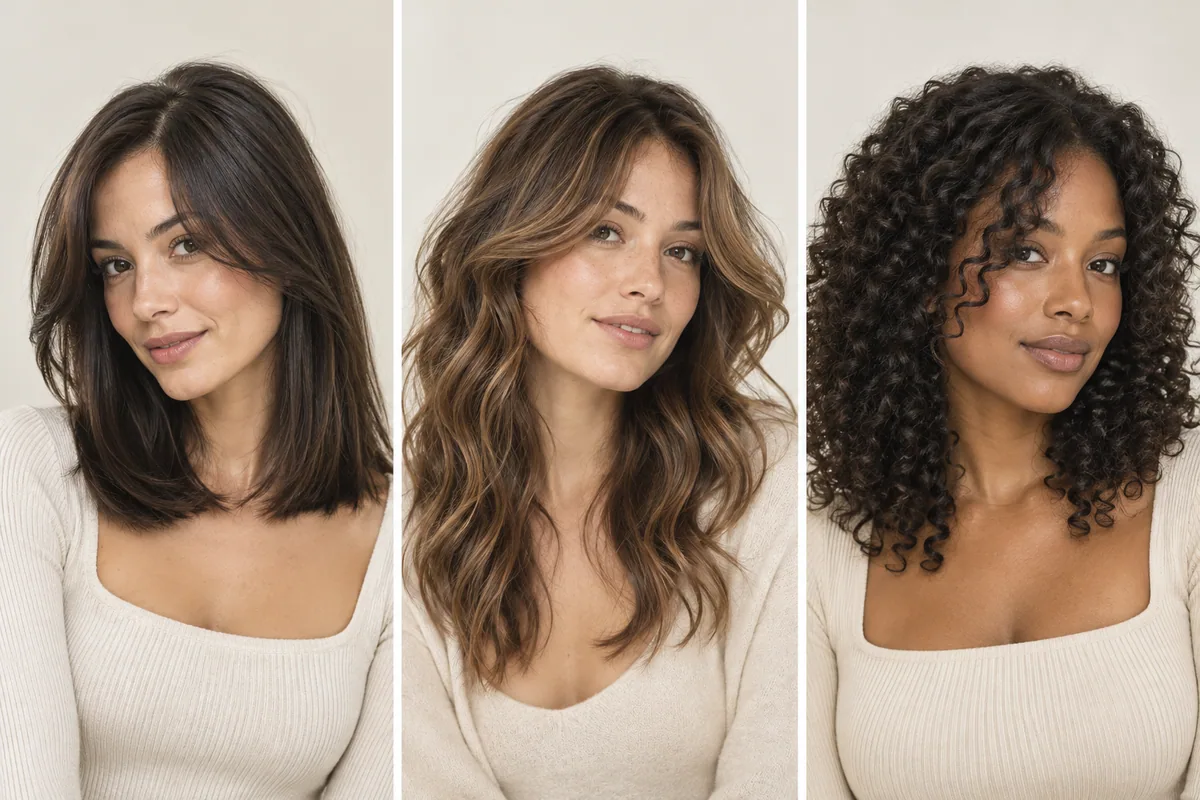
Yes, you can wear curtain bangs with a side part. The front does not have to split into two equal halves to frame your face. Moving the part gives one side more hair and can change how much of the forehead the fringe covers. The detail to plan is where the bangs open, as well as where the rest of your hair is parted.
This is especially useful if you like a curtain fringe but always end up moving your hair to one side. You can bring that habit into the haircut conversation instead of treating a center part as a condition of getting bangs.
Hairstylist Sally Hershberger confirms that side-parted curtain bangs can still frame the face in her original interview with Bustle. She explains that the hair falls more heavily on the side opposite the part. That uneven distribution is part of the look, rather than an error you must correct.
There are two parting decisions
Look at a front-facing photograph of yourself. First locate the part running back from your hairline. Then look at the opening between the pieces around your forehead. These lines can be related without being identical.
You might have an off-center part through the longer hair, with the fringe arranged into a small opening nearer the middle. Or you may prefer the whole front to sweep from the side. The second version usually looks more asymmetric because more of the fringe travels in one direction.
For the appointment, show both. Pointing only to a gap between the bangs can leave the rest of the parting unresolved. Pointing only to the scalp part can leave the stylist guessing whether you want hair across your forehead or a more open frame.
Use a simple description: “I want to keep this side part through the top, but I like a little space between the front pieces here.” A photograph with your finger indicating the intended opening is often clearer than naming a style variation.
Compare center, off-center and side positions
You do not have to choose the deepest possible side part to move away from a centered fringe. Compare three positions with the same hair, clothing and lighting. This keeps a change in makeup, camera angle or volume from making the choice for you.
On a small screen, swipe the table to compare every column.
| Position to explore | What to look at | A useful note for the salon |
|---|---|---|
| Near the center | How similar the two sides look and how much forehead is visible | “I like the opening, but the symmetry feels too deliberate.” |
| Slightly off-center | Whether a small shift gives the movement you wanted | “This amount of unevenness feels close to my normal hair.” |
| Farther to the side | The heavier sweep, the exposed side and the shortest pieces | “I want this sweep, but nothing repeatedly falling into this eye.” |
Treat these as preferences rather than a face-shape test. If you like an asymmetric frame, you do not need a rule that permits it. Our middle part versus side part article covers the overall parting choice; here, the focus is how that choice meets the fringe.
The generated illustration above shows possible visual directions. It does not demonstrate how a particular haircut changes when physically reparted, and it cannot tell you which arrangement your roots will hold.
Straight hair: inspect the line of the sweep
With a straighter finish, you may notice the fringe's diagonal line very clearly. Look at where that line crosses the brow, where the shortest pieces end, and whether the longer side continues into the haircut or appears to stop abruptly.
Save a reference with a finish you actually wear. If every picture has a large rounded bend, ask what the same front would look like without it. The answer could change how much length you want to keep. You may love a long, curved swoop yet dislike the same pieces falling straighter toward the eye.
Bring your normal styling routine into the discussion before agreeing on length. In Ellen Devine's fringe demonstration for Modern Salon, the Sam Villa educator emphasizes asking how someone styles their hair before deciding where to cut the fringe. A styled bend changes where the ends appear to sit.
You do not need to master a new brush technique before booking. Ask for a demonstration of the finish you are considering, then decide whether you would enjoy repeating it.
Wavy hair: watch the front over an ordinary day
A wave can make the two sides look different even when their cut lengths are similar. One piece may curve away from the forehead while another turns inward. For this reason, a still picture taken immediately after arranging the fringe is only one part of the decision.
Observe the front on a normal dry day. Take a picture when you first get ready and another later without rearranging it. Note the part that stayed comfortable and the pieces you kept moving. These are useful observations, not a test your hair has to pass.
If you like the side part but dislike the heavier side covering your eye, tell the stylist both things. You might discuss changing the opening, retaining more length for tucking, or choosing a different front shape. Do not assume the solution is simply to make everything shorter.
A helpful reference set includes a styled picture and a casual one. Label what you like in each: perhaps the polished picture has the opening you want, while the casual one has the wave and looseness you expect most days.
Curly curtain bangs with a side part
For curls, think in terms of the space around the face rather than perfectly matched strands. A side opening might leave one distinct curl near the center, or it might put most of the front volume on one side. Both can belong to the same broad curtain-fringe idea.
Ghd's curly curtain bangs guide describes a graduated front and stresses working with the existing curl pattern. That supports a practical consultation approach: show your dry curls as you usually wear them, then discuss the opening you want within that texture.
Photograph your fringe without stretching the curls into place. If you alternate between natural curls and a smooth finish, bring both references. Ask which look will guide the shortest length, and how the other finish is likely to differ.
The curtain bangs for curly hair guide covers dry length and side connection in detail. Keep the side-part request specific: “I like most of the fullness on this side, with a little open space here,” is more useful than asking every curl to land like a generated image.
Check the side you usually tuck away
Before cutting, demonstrate your normal tuck, clip or hair-up arrangement. Which front pieces need to move out of the way? Is one side nearly always behind your ear while the other stays loose?
It is easy to choose a fringe in a symmetrical front view and discover that your actual habits are asymmetric. If you use glasses, put them on during the consultation. Show where the frame sits and which pieces you tend to catch while taking the glasses off. A small inconvenience repeated all day can matter more than a subtle difference in a reference picture.
Also mention whether you change sides. A cut intended for one habitual part does not automatically behave the same when swept the other way. Ask the stylist to explain the tradeoff between a committed side shape and the flexibility you want. You can keep your preferences in the hairstyle-with-glasses checklist if frames are part of the decision.
Try the appearance before making the haircut request
To explore the look in Hair Magic, take or select a clear photo on your iPhone. Choose a supported hairstyle with a fringe, then inspect its available details. Use a parting option where the selected style offers one; not every style has the same controls.
Keep the color and general length similar while comparing. If changing the style also changes the texture, avoid attributing the entire difference to the side part. You are looking for a useful visual example, not a controlled prediction of how the haircut will behave.
Tap Generate to create the preview. Your photo is uploaded for cloud processing, so internet access is required. Compare the result with your original and inspect the heavier side, the opening and the area near each eye. Save a helpful image and write down the detail you would keep.
Hair Magic cannot establish which way a cowlick will fall, how individual curls will settle or how long a styled sweep will last. Use the image to discuss the appearance. The bangs filter guide explains supported exploration and the app's limits. The app is free to download with in-app purchases; generation access is shown in the app.
A salon request you can make specific
Try this starting point: “I want a curtain-style frame while keeping my usual side part. I like more hair on this side, but I want the shortest pieces clear of my eye when my hair is dry. Please show me how the opening will look with my normal texture and how much styling it will need.”
Add your own tucking, glasses or hair-up requirement. Bring the picture of your current part as well as the inspiration. The result you are agreeing on is a front shape you can recognize in everyday life, even when the two sides are not identical.
About this guidance. Published by Hair Magic, the app discussed here. Product details are based on the Hair Magic App Store listing, checked on 1 October 2026. This is planning guidance, not a professional assessment of your hair. AI previews are visual estimates; features and prices may change.
Read our editorial approach or explore all journal articles.