
Whether curtain bangs work without daily styling depends on your hair's natural fall and the finish you expect. A relaxed parted fringe and a raised, rounded sweep are different goals. Before cutting, ask what the proposed fringe would look like with the routine you actually intend to keep, including the days when you do very little.
You do not have to want a salon blowout every morning to enjoy bangs. But if the feature you love most is a smooth curve sitting away from the face, find out how that curve was created. The haircut and the finishing work need separate decisions.
Say what “without styling” means in your morning
For one person it means no heated tools. For another it means no products, no waiting for clips or rollers, and nothing beyond a quick comb. Someone else is happy to arrange the front after washing but does not want to repeat the process every day.
None of those definitions is wrong. They simply set different limits. Tell the stylist which actions you want to avoid rather than asking for low-maintenance curtain bangs and hoping you share the same definition.
Be honest about the time that matters. A technique can take only a few minutes of hand work but require waiting while the hair dries or sets. If you leave home straight after washing, that waiting time belongs in the plan too.
The low-maintenance haircut checklist covers your whole routine. For a fringe, narrow the question to the front: what are you prepared to do between washing it and walking out the door?
Separate the fringe from the finish in your reference
Look at the inspiration picture and name the detail that attracts you. Is it the open forehead, the shorter pieces beside the cheeks, the lift at the roots or the curled-out ends? The first two describe the shape you see; the last two may depend heavily on how the picture was styled.
Sam Villa's curtain-bangs tutorial includes a blow-drying finish after the cut. It is a useful reminder that a professional example of a haircut can also be an example of styling. The finished photo alone cannot tell you how it would sit after air-drying.
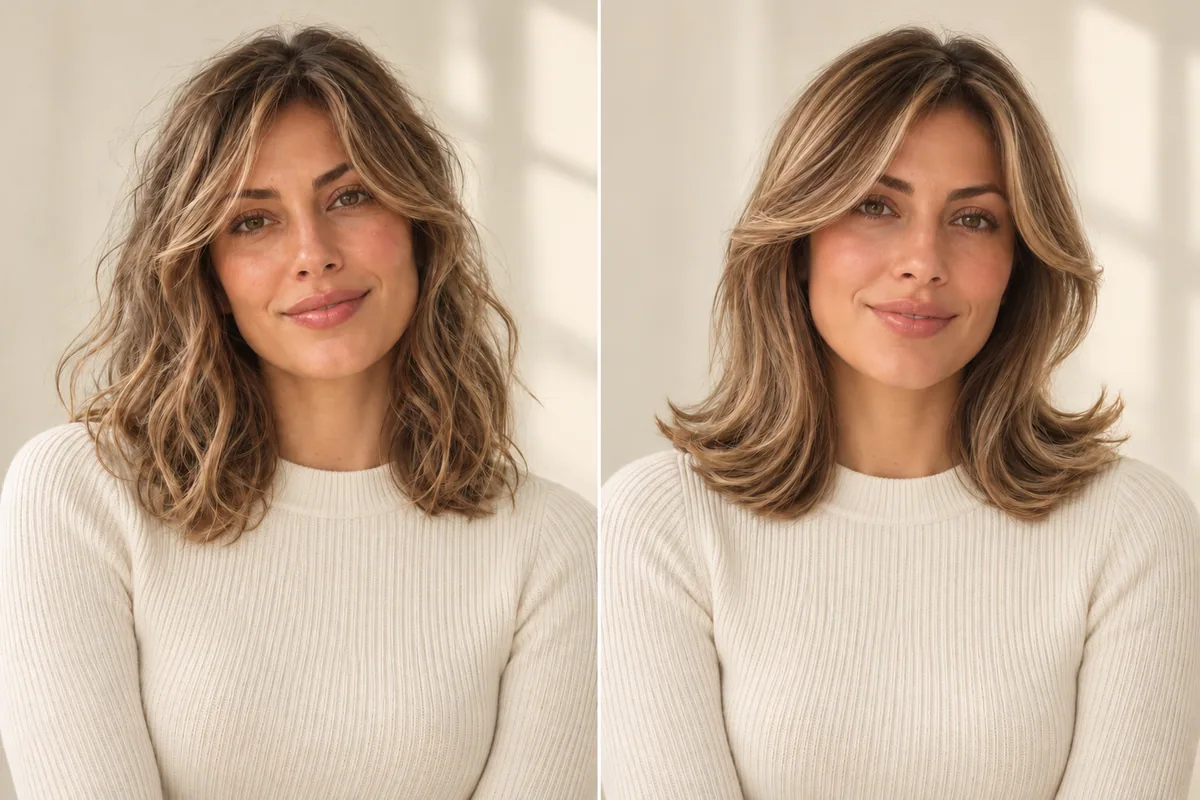
The generated illustration above contrasts a relaxed wavy appearance with a more polished rounded finish. It is conceptual artwork. Neither panel records a real routine, proves how little work the look takes or shows what your own fringe will do.
Save two references if necessary: one for the front shape you like and another for the everyday texture you want to preserve. Tell the stylist which job each image is doing. That is clearer than asking for a polished photograph to become a no-effort result.
Bring a picture from the middle of an ordinary day
A freshly arranged selfie can hide the exact behavior you want help with. Take another photo later, before pushing the front back into place. Use familiar lighting and keep your head level so the stylist can see what the hair is doing rather than a dramatic camera angle.
Note just three things: where the opening ends up, which pieces approach your eyes, and what you did to the hair before taking the photo. For example: “Washed last night, air-dried, brushed this morning; the left side keeps turning inward.” This is an observation about your current hair, not a prediction of a shorter cut.
If you have long front pieces now, do not assume their weight and behavior will stay the same after shortening them. Show the stylist the evidence you have, then ask what they expect to change. If you already have curtain bangs, the ordinary-day photo can help explain what feels inconvenient about the current length.
The photo guide is useful if you also want to make an app preview. Keep the everyday reference, even if you choose a neater, clearer photo for the visual comparison.
Straight, wavy and curly hair raise different questions
With a straighter finish, look at whether the front falls flat, bends near the ends or separates where you want it to. If you like a large outward curve in your reference, ask what remains of that appearance without deliberately shaping it. There is no need to treat flatter hair as a failed version; you may prefer it.
With waves, notice whether the two sides turn in similar directions. A looser opening may be comfortable even when the fringe is not mirrored. If you only like the look when both sides form matching curves, tell the stylist that consistency matters to you.
With curls, show the front in its usual dry shape. Ghd's curly curtain bangs guidance, with advice from Grant Williams, emphasizes working with the existing curl pattern rather than forcing a fixed arrangement. Ask what amount of placement or refreshing the proposed fringe would need within your routine.
Our curly curtain bangs article goes further into dry length and the opening. No texture category gives a universal yes or no to air-dried bangs. The useful evidence is your own hair and the exact finish you want.
Take a time-and-tools worksheet to the appointment
Fill this in before the consultation. A realistic answer is more useful than the routine you might enjoy once a month.
On a small screen, swipe the table to compare every column.
| Part of the routine | What to write down | What to ask the stylist |
|---|---|---|
| After washing | What you already do to the front | Which of those steps would need to change? |
| Between washes | Whether you wet, arrange or leave the fringe alone | What is the smallest useful refresh for this cut? |
| Tools | What you own and actually like using | Does the proposed finish depend on another tool? |
| Waiting | Whether you can leave clips or rollers in while getting ready | What happens if I skip that stage? |
| Busy-day fallback | Tuck, clip, headband or loose fringe | Will the shortest pieces allow that option? |
Make the limit concrete. You could say: “I can arrange the front after washing, but I do not want to wet it and start again every morning.” Or: “I am happy with an uneven opening; I mainly need the hair away from my eyes.”
Ask the stylist to demonstrate the minimum routine they recommend for the proposed result. Watch the complete sequence, including preparation and finishing, rather than counting only the final brush pass. If it involves something you know you will skip, say so while the plan can still change.
Choose a fallback you would actually wear
An easy fringe needs a workable plan for the day when you are late or simply uninterested in arranging it. Decide whether a clip is an acceptable solution or whether you need the front to stay tucked without one.
Demonstrate that action before cutting. The shortest pieces may not participate even when the longer side sections do. If the fallback is non-negotiable, ask which length or shape would preserve it.
If you always sweep your hair to one side, consider whether maintaining a centered opening would be an added task. The side-part curtain bangs guide explores a more asymmetric frame. If you mainly want movement beside the face, longer face-framing layers offer a different question to take to the consultation.
You can also decide to keep a longer first version and reassess. That is not a guarantee of less styling, but it can make sense when retaining a particular tuck or clip option matters more than matching the shortest pieces in a reference.
Preview a look, then check its routine separately
Hair Magic can help you decide whether you like the appearance of a supported fringe on your photo. Choose or take a clear picture on your iPhone, browse the hairstyle catalog and inspect the details available for the selected look. Bangs, parting and texture-finish options vary by style.
Keep the color steady while comparing the front. When ready, tap Generate; your photo is uploaded for cloud processing, so internet access is required. Review the preview beside your original and save a useful reference if it helps you explain the amount of opening or side length you want.
The app does not simulate air-drying, diagnose root direction or measure how long a morning routine will take. A relaxed-looking generated fringe might still need real styling to achieve. Use the bangs preview guide for appearance planning, then ask the stylist about the work behind the result. Hair Magic is free to download with in-app purchases; check generation access in the app.
Keep the image and your routine limit together in your Salon Card or appointment notes. A useful final request is: “I like this open fringe, and this is how my hair looks after my normal routine. I want a version I enjoy on those days too. Please show me what I would need to do, and what would look different if I skipped it.”
About this guidance. Published by Hair Magic, the app discussed here. Product details are based on the Hair Magic App Store listing, checked on 18 October 2026. This is planning guidance, not a professional assessment of your hair. AI previews are visual estimates; features and prices may change.
Read our editorial approach or explore all journal articles.