
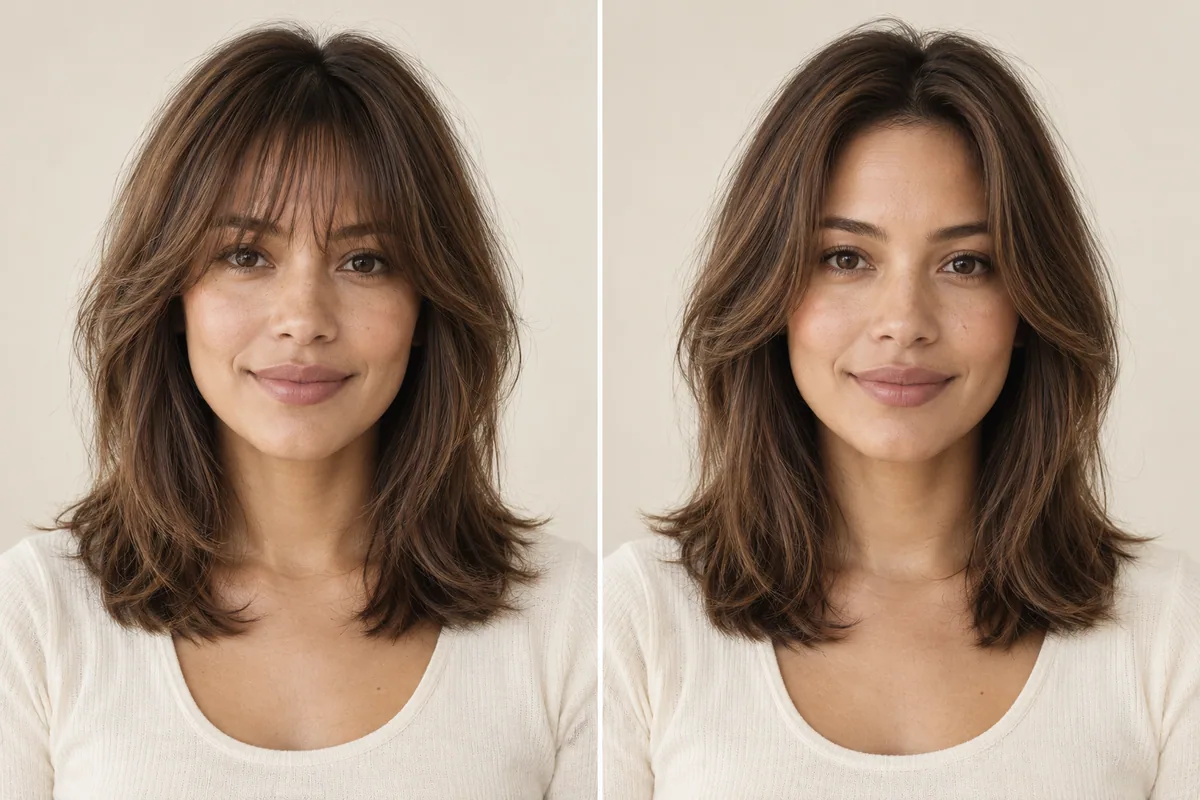
Bangs usually bring shorter hair into the forehead area. Face-framing layers shape the hair beside the face, often leaving more of the forehead open. The terms overlap, especially with long curtain bangs. For a haircut decision, compare where the shortest pieces end, what they cover and whether they need to tuck or tie back.
If you want your hair to feel different but cannot decide whether you want a fringe, this is a useful place to start. You can change the front without treating every layer near your cheek as bangs, or every fringe as a solid line across your forehead.
Decide what you want to change in the mirror
Pull the longer hair back and look at the front. Would you like hair to sit across some of your forehead? Or are you mostly missing movement beside the cheeks and jaw when your hair is down?
Those requests can lead to different cuts. Someone who wants a visible fringe with a ponytail is asking for short pieces to remain out. Someone who wants all the front hair off their face when tied back is asking for those pieces to reach the tie. Both may like the same long-haired reference while wanting very different everyday results.
Write the change in one sentence before collecting more pictures: “I want a fringe when my hair is up,” or “I want the sides to have more shape, but I still want to pull everything back.” That sentence gives the consultation a practical direction.
The illustration above contrasts two front shapes. It is an AI-generated editorial example, not a salon result or proof that a particular amount of hair can be preserved on your head.
Where curtain bangs blur the distinction
Long curtain bangs can look much like short face-framing layers. Their name alone does not settle whether they sit near the eyes, cheeks or chin, or how distinctly they separate from the rest of the haircut.
Professional examples use a broad range of lengths. In Ellen Devine's fringe demonstration published by Modern Salon, the curtain version falls around the chin and can be moved to the sides. That illustrates why a long reference might reasonably be described as both fringe and face framing.
Rather than debating the label, point to the shortest piece in the picture. Ask where that piece would finish in your normal dry hair. Then follow the next pieces down to see how the shape joins the overall length.
The butterfly haircut versus long layers comparison addresses a larger layered silhouette. You do not need that full haircut simply because you like its front pieces. Tell the stylist which part of the reference you want to borrow and which parts of your current cut you want to keep.
Compare the practical differences
On a small screen, swipe the table to compare every column.
| Your priority | What to inspect in a bangs reference | What to inspect in a longer face frame |
|---|---|---|
| Forehead coverage | The amount of hair across the center and brows | Whether the front stays open or sometimes sweeps across |
| Ear tucking | Which sections remain too short to stay tucked | Whether the shortest side pieces actually reach and stay behind the ear |
| Ponytails and clips | The fringe that will remain loose | The front sections most likely to fall out |
| Glasses | Where the fringe meets the upper rim | Whether the side pieces catch around the temples |
| Grow-out | The shape you want as the shortest pieces lengthen | Whether you intend to keep the frame or return toward one length |
These are checks, not guarantees attached to each name. A long fringe may tuck. Short face-framing layers may not. Your head shape, starting length, texture and chosen tie position all matter, so demonstrate the action rather than assuming a category settles it.
The shortest piece deserves its own decision
A haircut can preserve the back length while removing a surprising amount from the front. If keeping length matters to you, specify where it matters. “Only a small trim” can mean something different to you and the stylist unless you discuss the front separately.
Identify a visual landmark you are comfortable with: around the brow, cheekbone, jaw or below the chin. This is a way to show your preference, not a cutting measurement. Your stylist still needs to account for your usual texture and finish.
Then decide how much hair should live at that shorter length. A few isolated pieces and a fuller front section can have a different effect even when their ends finish at the same point. You do not need to choose a technical sectioning pattern; show the desired amount of coverage and let the stylist explain how they would create it.
For curly or wavy hair, use dry references. If a piece looks long while stretched but sits near the eye in your normal curl, that dry position is relevant to comfort. Make clear whether the inspiration shows your everyday finish or a special styled version.
Three salon briefs for different priorities
These are example requests to adapt, rather than promises about what a stylist can achieve on every head of hair. Each one sets a different boundary before the haircut name enters the conversation.
1. You want a noticeable change with your hair tied up
“I wear a ponytail most days and want some hair around my forehead instead of pulling everything back. I like a light front rather than a solid heavy fringe. Please show me where the shortest pieces will sit dry, and which side sections will stay loose.”
This brief makes the hair-up appearance central. Bring a picture of your normal ponytail and a reference showing the fringe with the rest of the hair tied back. A hair-down photograph alone cannot show that relationship clearly.
2. You want movement while keeping the front out of your face
“My hair feels flat around the sides, but I do not want a short fringe. I want to tuck the front behind my ears and pull it back for work. Can we add a longer face frame while keeping the pieces I need for those actions?”
Demonstrate the tuck and tie before the cut. If the exact shape in your reference conflicts with those requirements, ask which part would need to change. Keeping the practical requirement may mean choosing a subtler frame, and that is useful to know before losing the length.
3. You like curtain bangs but want a cautious first version
“I like the open front in this picture, but I am unsure about the short center. Could we discuss a longer starting version? I want to see how it feels around my cheeks before deciding whether to add shorter pieces later.”
This is a request for a staged decision, not an assurance that a long version will behave like a short one. Ask how the suggested first cut would look now, and what would change if you shortened the middle at another appointment.
Plan the version you will wear on a busy morning
A reference folder often shows the best few seconds of someone else's hair day. The fringe is arranged; the face frame has an even bend; loose pieces are exactly where the camera wants them. You need a plan for the version you will wear while making coffee or leaving for work.
Describe the styling you already do. If you rarely shape the front, ask what the proposed cut will look like after your usual routine. If you enjoy arranging a fringe but dislike frequent appointments, ask how the outline will change as it grows.
Also consider the moment when you want the hair gone from your face. Would a small clip be acceptable, or do you need every front section to join the rest without one? Neither preference is more sensible. The haircut should be planned around the answer you can live with.
If you are already growing a fringe out, read growing out bangs before asking for more face framing. You may want to preserve the progress at the shortest point while adjusting the connection around it, rather than start the short stage again.
Compare the front shape in Hair Magic
Use Hair Magic on your iPhone to explore the appearance of a supported bangs style and a longer front-shape option. Begin with the same clear photo and keep the overall length and color as similar as the available choices allow. Choose the closest front shape in the catalog, then check which details you can adjust for that style.
The useful comparison is the area from the hairline to the jaw. Notice how much of your forehead remains visible, where the shortest pieces appear and how the front meets the sides. If the AI also changes the volume or texture, note that before deciding which part of the result you like.
When you tap Generate, the photo is uploaded for cloud processing; an internet connection is required. The bangs preview guide walks through the supported workflow. Hair Magic is free to download with in-app purchases, and the app shows the generation access available to you.
A preview cannot test ear tucking, tie-back reach or the way a cowlick settles. Save the image as an appearance reference and pair it with your practical request. Use a Salon Card for the selected style and relevant details, with your own requirement notes alongside it.
At the appointment, ask the stylist to show the shortest proposed piece and explain what it will do in your everyday hairstyle. Once you agree on that, the choice between bangs and face-framing layers becomes much easier to describe.
About this guidance. Published by Hair Magic, the app discussed here. Product details are based on the Hair Magic App Store listing, checked on 1 October 2026. This is planning guidance, not a professional assessment of your hair. AI previews are visual estimates; features and prices may change.
Read our editorial approach or explore all journal articles.