
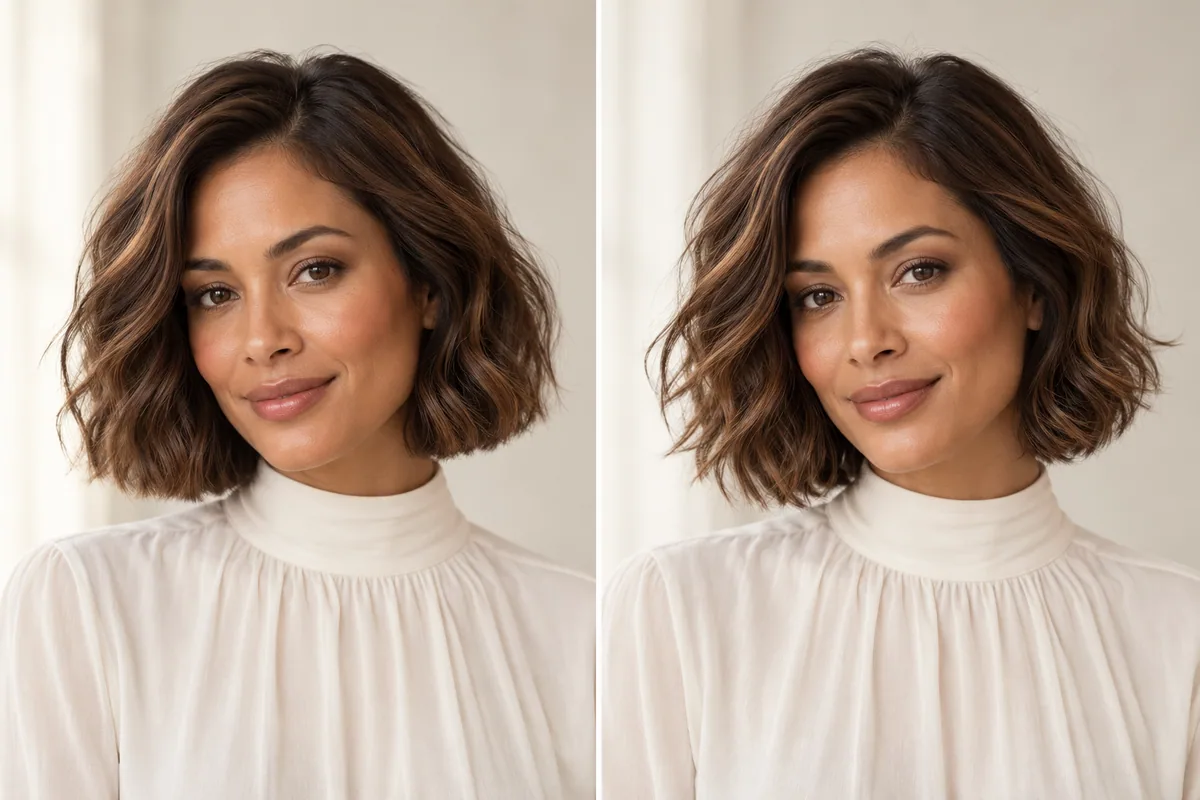
A wavy bob haircut is easier to choose when you separate the lower outline from the waves moving through it. You might prefer a clearer edge, a softer layered shape or longer pieces at the front. Then decide where the bob should end and which finish resembles your ordinary hair.
The wave can make very different cuts look similar in a photograph. It can also make the same broad length look different from one day to the next. Instead of saving a large gallery of attractive bobs, find a few references that help answer one specific question about the shape.
Are you choosing natural waves or a styled finish?
Ask what is doing most of the work in the inspiration photo. Do the waves resemble your usual bends, or does the image show carefully arranged curls and turned ends? Either can be a valid target, but they imply different conversations about your routine.
Hair.com's guide to wavy haircuts includes bob directions among its examples. Use published photographs to explore possibilities, then bring your own dry-hair references so the stylist can discuss the starting point.
If you like styling waves into straighter hair, describe that as part of the plan. If you want to work mainly with natural waves, bring the version you actually wear after washing. A bob label does not explain which of those finishes you mean.
Decide where the lower edge should appear
Look at the visible endpoint: near the jaw, below the chin, partway down the neck or closer to the shoulders. Use those landmarks on your own head when discussing the preferred length. The photographed model's proportions are not cutting measurements.
Ask about the intended dry appearance, especially when your reference's ends are strongly curved. A short-looking photograph can leave uncertainty about how much length is present underneath the arranged bend.
If you are still deciding between a bob and a longer shape, read bob versus lob. This guide assumes you are exploring a bob direction and want to narrow its outline, rather than settle the whole short-versus-long decision again.
Compare a clear edge with a softer outline
Cover the upper hair and study only the bottom. Does the edge read as a distinct line, a rounded band or a more separated collection of ends? Say which appearance you like without assuming that one cutting technique will reproduce it on every head.
Next, uncover the photograph. Do you still prefer that edge when you see the full hairstyle? Sometimes the appeal is the contrast between a clear lower outline and loose waves above it. Sometimes the preferred look is softness all the way through.
Our blunt cut versus layered hair article explains the broader distinction. For this comparison, keep the length and wave character as similar as possible so you can see the lower edge rather than a completely different style.
On a small screen, swipe the table to compare every column.
| Wavy bob direction | What to look at | What to ask |
|---|---|---|
| Clearer lower edge | How continuous the outline looks between the waves | How could we keep this appearance on my starting hair? |
| Softer layered outline | Where the visible shorter pieces sit | Where would the shorter pieces sit when I wear my hair normally? |
| Longer front pieces | The relationship between the side front and the back | What should the side and rear views look like? |
| Rounded shape | Where the outline looks widest or most curved | How much of this shape is arranged styling? |
You may want a combination. A reference set is useful when it makes that combination explicit, not when it asks the stylist to average several unrelated photographs.
Look at the front separately
A bob can feel quite different with an open forehead, a long side frame or a shorter fringe. Pull the longer hair away from the face in your mind and inspect the remaining front pieces. Would you still enjoy that arrangement?
Decide how you want the front to meet your everyday glasses and which pieces you like to tuck away. Demonstrate those actions at the consultation. A generated picture cannot test reach or comfort.
If the fringe is your main uncertainty, compare a bob with and without bangs. If you are exploring named bob variations, the French-versus-Italian bob guide helps you translate the labels into an outline and front shape.
Bring a side view and a less arranged day
The back and side of a bob deserve their own reference. A front image may hide the neckline, the relationship between front and back or a change in the shape behind the ears. Ask for another view instead of making assumptions.
Add one photo of your own hair on a day that represents your normal routine. You do not need to make it look worse or better for the appointment. The point is to show the wave and the habits the stylist is planning around.
Explain what happens after the first wash day too. If you regularly restyle the front, say so. If you prefer to secure it on later days, show how. These details make the request more realistic than simply asking for a bob that looks effortless.
Keep the practical requirements visible
Before choosing a shorter edge, list what must still work: clearing a collar, fitting under headphones, tucking a side section or securing the front. Not every requirement will matter to every reader.
If a full ponytail is important, show the position you use rather than assuming any bob will reach. Our short hair and ponytail guide can help prepare that conversation. You may decide to keep a longer outline, change how you secure it or choose a different haircut altogether.
A useful consultation lets you see the tradeoff before the cut, not discover it because a reference photograph left the practical detail out.
Preview a wavy bob direction in Hair Magic
Take or select a clear photo and browse the bob catalog. Choose the closest available outline and explore supported texture, length or fringe details. Keep the color similar while you compare the cut. Controls vary by selected hairstyle, and not every reference has an exact named match.
The bob-filter guide explains the workflow. Tap Generate when ready to upload your photo for cloud processing; internet is required. Review each result beside the original.
Look at the lower edge, the area beside the jaw and the amount of neck visible. Do not use extra generated fullness as proof of what your hair will do. A preview cannot simulate the way your waves will settle, establish the cutting technique or predict a wash-day routine.
Hair Magic is free to download with in-app purchases. Check current preview access in the app. Save the image if it helps you explain one part of the outline, even if you need to reject another detail.
Write a brief around the edge you chose
Try this structure: “The dry edge should appear around… I prefer a clearer/softer outline here… Keep the front… My normal finish is…”. Add a practical requirement only if it matters to you.
A fictional example might be: “Keep the dry outline below my chin, with a clearer edge than this more separated reference. Leave the front open. I usually wear my natural waves and want to keep this side section long enough to clip away.”
Put the selected hairstyle and practical notes in a Salon Card. Take the real wave photographs and side-view reference as well. Together, they explain more than a folder full of bobs with no notes about what you liked.
About this guidance. Published by Hair Magic, the app discussed here. Product details are based on the Hair Magic App Store listing, checked on 1 November 2026. This is planning guidance, not a professional assessment of your hair. AI previews are visual estimates; features and prices may change.
Read our editorial approach or explore all journal articles.