
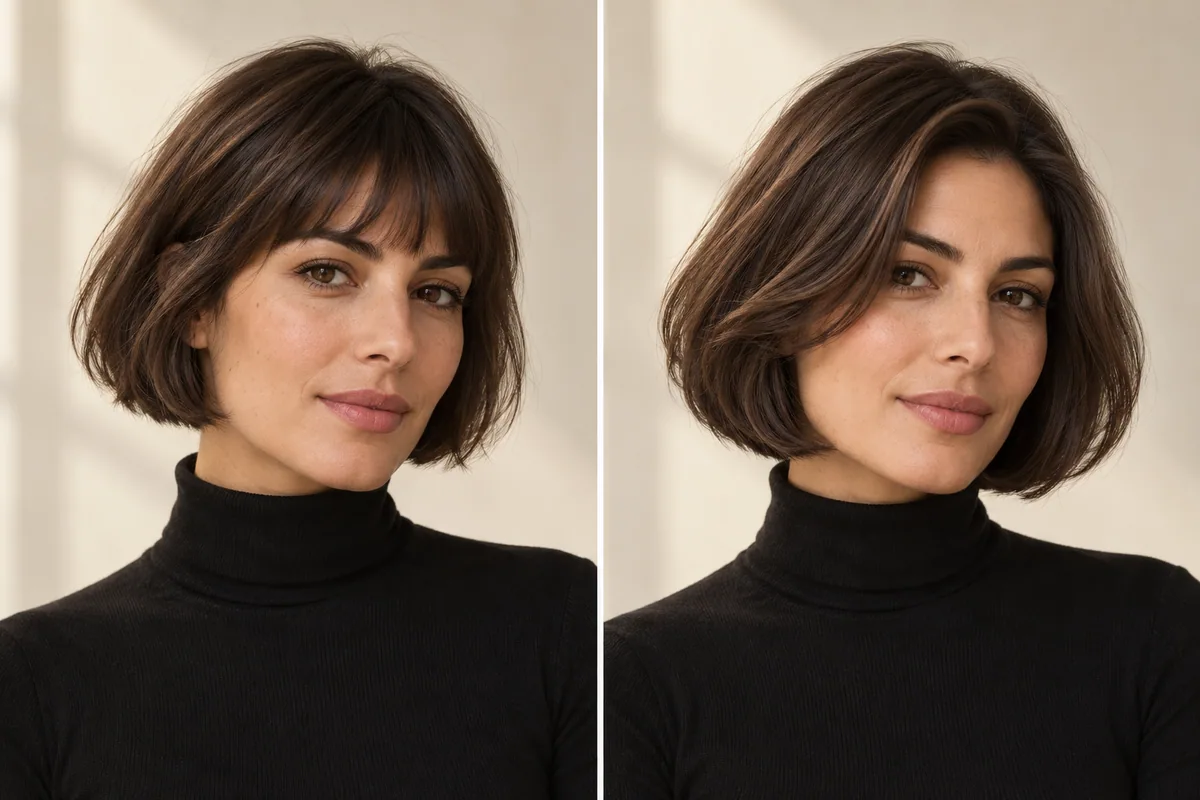
A French bob often suggests a compact shape with fringe; an Italian bob often suggests a fuller or more fluid outline. When you compare French and Italian bobs, the names do not settle the exact length, layers or finish. Choose the visible details you want first, then use the label to start the salon conversation.
If every saved photo seems to contradict the last, that is a reason to describe the haircut more precisely. You can want a jaw-level outline, an open forehead and a particular amount of movement without needing one trend name to contain all three choices.
Why the examples do not always agree
Hair.com's French bob guide describes a compact cut associated with fringe and soft layering. Its Italian bob guide presents a longer, fluid interpretation, while L'Oréal Paris includes a chin-level Italian bob among its examples. That variation is why a photograph and a length landmark matter more than the name alone.
The illustration above shows two possible directions at relatively short lengths. It is a visual comparison, not an assertion that every French or Italian bob must look that way. You may prefer a combination of their features.
Start by saving one reference you actually like from each group. Ignore which name appears in the caption and write down what you would want to copy from the image.
Choose your length landmark first
Does the lower edge sit near the jaw, under the chin, between the chin and shoulders, or near the shoulders? Looking at that landmark on the person in the photograph is more useful than reading “short” or “long” beside it.
Now consider where you would like the edge to appear on your own head. A reference model's jaw, neck and posture are not measurements for your haircut. Ask the stylist to show the intended dry endpoint before you agree on the plan.
If the length itself is still undecided, pause the French-versus-Italian comparison and read bob versus lob. You may need to settle how much shorter you want to go before discussing a particular bob interpretation.
Compare the lower outline
Look at the bottom third of each photograph. Does the hair read as a clear edge, a rounded shape, a lightly separated edge or a tapered outline? That is where a word such as “fuller” needs a visual example.
It does not mean one named bob creates more hair than the other. Hair density, the starting cut and styling all affect the picture. Describe the appearance you want, then let the stylist explain what is possible with the hair in front of them.
Try these observations:
- I like how clearly I can see the lower line in this photo.
- I prefer the roundness beside the jaw in the other image.
- I want some movement, but I do not want the ends to look very separated.
- I like the way the front sits, but the back is not visible enough to judge.
For the last point, ask for another view. A persuasive front portrait may leave the neckline and back shape almost entirely unexplained.
Make the fringe a separate decision
A fringe can change the impression so much that it hides what you are actually comparing. If one reference has forehead bangs and the other has an open front, decide whether that difference accounts for most of your preference.
You may like a compact bob and want no fringe. You may prefer the fuller outline but want shorter pieces at the forehead. Show that combination rather than assuming it is forbidden because it does not match a traditional label.
Our bob with bangs versus without bangs article focuses on that choice. If you are considering a longer parted front, use the curtain-fringe length guide to describe the endpoint.
Read the finish as carefully as the cut
A smooth bob turned neatly underneath can look very different from the same broad length worn with waves. A side part can also change which side looks fuller. Before choosing between two photos, note the finish and parting in each.
Find a second pair with more similar styling if possible. You do not have to remove styling from the decision; you only need to recognize when it is the part you love.
On a small screen, swipe the table to compare every column.
| Decision | Compare in the photographs | Confirm at the consultation |
|---|---|---|
| Length | Where the lower edge appears | The intended endpoint on your own hair |
| Outline | Clear, rounded or more separated ends | What would create the chosen shape on your starting cut |
| Front | Forehead coverage and side-piece length | The shortest front section and its connection |
| Parting | Center, off-center or side | Your normal part, including any practical limits |
| Finish | Sleek, gently waved or visibly arranged | The routine needed for the appearance you are choosing |
If your references are naturally waved, the wavy bob guide helps separate the edge of the cut from the bends through it.
Check the ordinary-day requirements
What do you need the haircut to do between salon photographs? You may wear glasses, secure the front for work or prefer the hair clear of a collar. Demonstrate the actions that matter and let the stylist assess them.
A shorter bob does not automatically promise a faster morning. A fuller-looking reference does not automatically promise fewer appointments. Ask about the appearance you want to maintain and what changes as the cut grows, rather than requesting a generic low-maintenance label.
The low-maintenance haircut checklist is useful if you have not yet decided what that means for you. A specific routine is easier to plan around than an adjective.
Compare supported bob shapes in Hair Magic
Take or choose a clear photo in Hair Magic and browse the bob styles available. Pick the closest outline to the first reference, then explore a second supported direction. Keep your color similar so a new shade does not decide the haircut comparison for you.
Length, fringe, texture and other details vary by selected style. Do not expect a menu option named exactly after either reference. The bob haircut filter guide explains how to work from the available catalog.
Tap Generate to upload the photo for cloud processing; an internet connection is required. Review the preview beside your original and note the jaw, neckline and front shape. Treat extra fullness or perfectly arranged ends as illustration, not a prediction of the real cut.
Hair Magic is free to download with in-app purchases, and current preview access is shown in the app. Save an image that communicates the useful part, even if you need to add a note saying that the fringe or finish should be different.
Build a brief that survives a change of label
Write your request without either national name. Include the lower endpoint, the outline, the front and the everyday finish. If the description is clear without “French” or “Italian,” you have something useful to discuss.
A fictional brief might be: “I want the edge around this point below my chin, a rounded-looking lower shape and an open forehead. I like the gentle movement in this picture, but I do not plan to style it this fully every day.”
Use a Salon Card to organize the selected direction and practical notes. You can still mention the bob name you searched. It simply no longer has to carry the entire haircut request.
About this guidance. Published by Hair Magic, the app discussed here. Product details are based on the Hair Magic App Store listing, checked on 1 November 2026. This is planning guidance, not a professional assessment of your hair. AI previews are visual estimates; features and prices may change.
Read our editorial approach or explore all journal articles.