
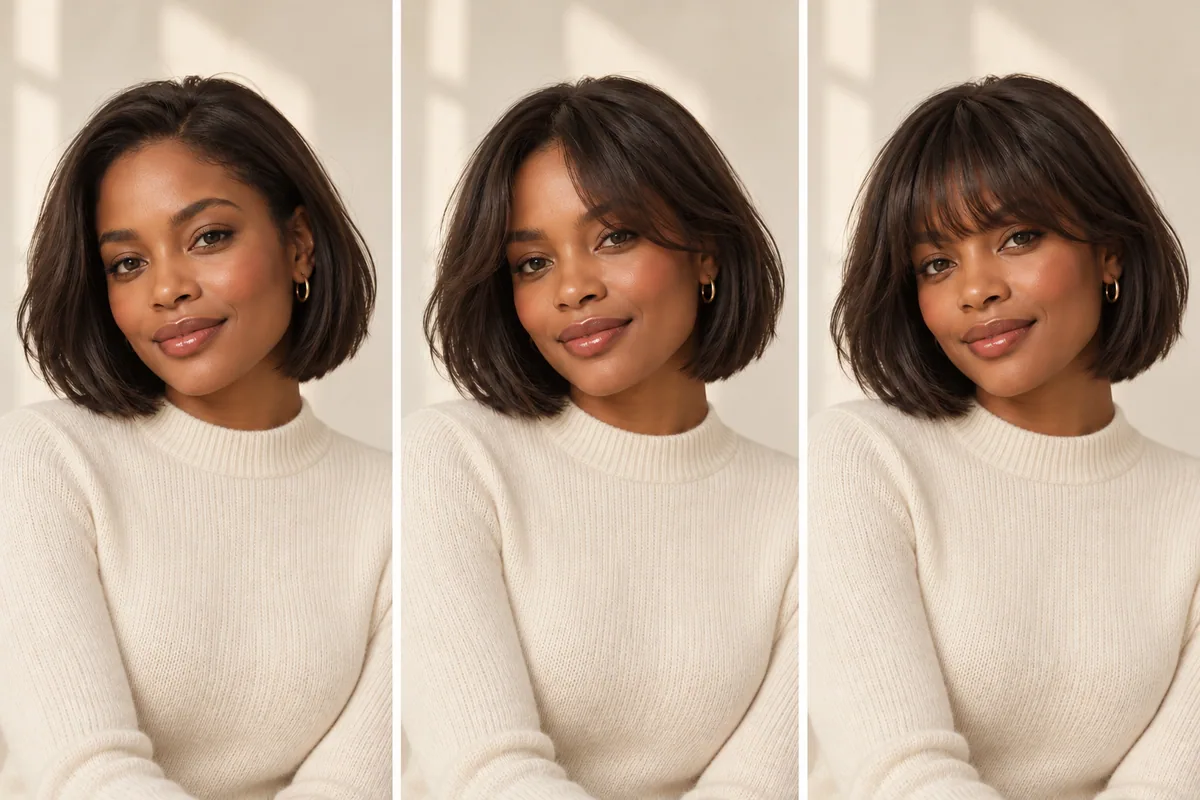
When comparing a bob with bangs versus without bangs, keep the bob length similar and look at what changes around the forehead and eyes. Without a fringe, longer front sections can leave the forehead open or frame its sides. With bangs, shorter pieces introduce a new edge or opening above the eyes. Neither version is the required finish for a bob; choose the front shape you enjoy and the daily handling you want.
It helps to have three options rather than a yes-or-no decision: no fringe, an open fringe and a fuller fringe. You may discover that you want some shorter framing without wanting a continuous line across the forehead.
Choose the bob length first, then hold it steady
A chin-length bob with full bangs and a shoulder-length bob without them differ in at least two major ways. If you prefer the second picture, you cannot tell whether it is the length, the forehead coverage or both that appeals.
Start with an approximate landmark for the outline: near the jaw, below it or nearer the shoulders. Then look for front-shape references at a similar length and color. You do not need exact copies; the aim is to reduce distracting differences.
The bob versus lob comparison covers the length decision if that is still unsettled. Hair.com's bob styling overview also presents the classic bob with and without bangs. A fringe is one choice within the haircut, not what makes the haircut count as a bob.
Three front shapes to put beside each other
Use these descriptions as visual labels. Salon names can overlap, and an open fringe can vary widely in length and coverage. Point to the feature you mean instead of expecting a name to settle the details.
On a small screen, swipe the table to compare every column.
| Front shape | What you are comparing | Practical question |
|---|---|---|
| No shorter fringe | Longer front sections and a more open forehead | “Can the front tuck the way I normally wear it?” |
| Open fringe | Shorter framing with a visible opening through the center or toward one side | “Where do the shortest pieces sit when I leave them alone?” |
| Fuller fringe | More continuous coverage across part of the forehead | “Where should the dry edge sit above my eyes or glasses?” |
The three portraits on this page are generated editorial illustrations of those broad directions. They are not a controlled haircut trial or proof of Hair Magic's exact available controls. Use them to decide which feature deserves a closer look on your own photo.
If your preferred option is somewhere between longer front sections and a distinct fringe, read bangs versus face-framing layers. That distinction is more useful than forcing your choice into “bangs” or “no bangs” too soon.
Notice the forehead, the eyes and the jaw separately
First look at the whole silhouette. Does the bob feel as open or enclosed around the face as you want? Then look at the forehead. Decide whether you enjoy a clear area above the brows, a broken opening or more coverage.
Next, check the eyes. A reference may look appealing with one long piece crossing an eye, yet you may dislike moving hair away during the day. That is a practical preference worth stating. You do not have to accept every detail of an attractive image.
Finally, look at the bob's lower edge near the jaw. Keep that assessment separate from the fringe. You might love the bottom outline in one image and the front coverage in another. Mark both preferences so the stylist understands which part of each reference you are borrowing.
Avoid turning this into a rule about which faces are allowed to wear bangs. The useful observations are “I like this open space” or “I prefer a softer border here.” They tell the stylist what you enjoy without asking the haircut to correct your face.
Test tucking, glasses and clips as separate requirements
Think about the gestures you already make. Do you tuck both sides behind your ears while working? Push the front back to wash your face? Switch between glasses and sunglasses? Each action helps explain how much length you want near the front.
Demonstrate the important one at your appointment. “I need the front to tuck behind my ears” does not necessarily mean “every fringe piece must reach.” Specify which sections you mean. If shorter pieces staying loose would bother you, say so before they become part of the plan.
For glasses, use the pair you actually wear. Compare the preferred fringe edge with the top of the frame, and explain whether hair touching the lenses annoys you. Our hairstyles with glasses article provides a more detailed way to record those observations.
You can also decide that a small clip is an acceptable backup. The important point is that it should be a choice you make now, not an extra daily step you discover after the haircut.
A different shape may mean a different routine
Ask what the proposed front would look like in your usual dry finish. A blow-dried fringe in a reference does not explain how your own front sections settle, what happens around a parting or how much arranging you will enjoy doing.
Do not assume that no bangs means no styling, or that every fringe demands the same upkeep. Ask about this exact shape: which section would you refresh first as it grows, what would the stylist demonstrate for daily arranging, and what would your simpler alternative be on a busy morning?
Growing out is part of that conversation. If you are happy to pin or sweep the front as it gets longer, note that. If you strongly dislike intermediate lengths around your eyes, make the preference clear. The growing-out-bangs guide helps you consider those later stages without guessing a universal timetable.
Two salon briefs with different priorities
You want the bob to be the main change. A possible request is: “I want this outline below my jaw, but I am undecided about bangs. Please keep the front long enough for my usual tuck while we settle the length. I can revisit a shorter fringe if I still want it.” This is a way to separate decisions, not a promise that every later fringe is feasible without another assessment.
You already know you want more forehead coverage. Try: “I like the fuller front in this picture, with the same bob length as the other reference. I want my eyes clear and do not want to keep pushing hair off these glasses. Please show me the finished dry length and explain how you would arrange it.”
These fictional examples prioritize different things. The first protects an existing habit; the second defines the fringe rather than just asking for “a bob with bangs.”
Explore a bob direction on your photo
Open Hair Magic for iPhone, choose a clear photo and browse supported bob styles. Keep the color and approximate length steady. Check whether the selected style offers a bangs or parting detail before changing it. If one style does not provide every option you want, compare separate available directions and note the other differences between them.
The bob cut preview guide explains the overall workflow, while the bangs filter guide focuses on the front. Generation starts after you review the choices and tap Generate; the photo uploads for cloud processing and requires internet access. Downloading the app is free, with in-app purchases, and preview access is shown in the app.
Compare the result with your original. Use it to judge broad coverage and shape, not to predict a cowlick, exact fringe fall or comfort around glasses. Save the clearest direction and write one sentence beside it: “This is the front I like, and this is what it must let me do.” Take that sentence and the reference to your stylist before choosing the shortest pieces.
About this guidance. Published by Hair Magic, the app discussed here. Product details are based on the Hair Magic App Store listing, checked on 18 October 2026. This is planning guidance, not a professional assessment of your hair. AI previews are visual estimates; features and prices may change.
Read our editorial approach or explore all journal articles.