
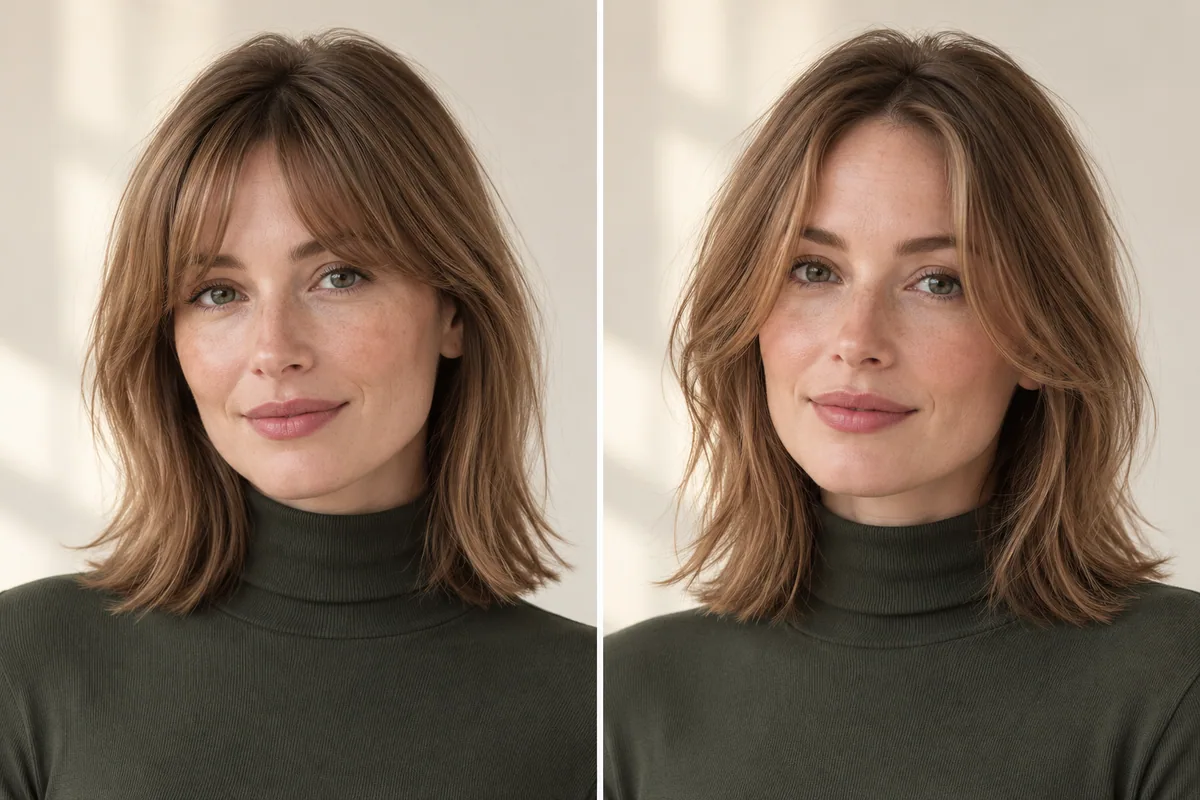
Curtain bangs for fine hair are worth discussing in terms of the front section, the opening you want and the hair left beside it. Fine strands do not automatically rule a fringe in or out. The important decision is what your own hair can support while keeping the rest of the outline you enjoy.
A photo with a full, airy fringe can be persuasive. Before choosing it, ask whether you like the length, the forehead coverage or mainly the impressive styling. Those details can be discussed separately, and a generated preview should not turn any of them into a promise of added hair.
Fine strands and low density are different questions
Hair.com's explanation of fine and thin hair distinguishes individual strand diameter from the amount of hair present. Someone can have fine strands and plenty of hair; another person can have less hair overall with a different strand thickness.
That distinction matters when a reference shows a dense fringe. “Fine hair” alone does not explain how much hair is available at the front, how it grows or how the proposed fringe would affect the sides. A stylist needs to examine those details on the actual starting hair.
This article is about choosing the appearance of a haircut. It is not a way to diagnose changes in hair density. If your question is about the whole haircut rather than the fringe, begin with our fine-hair haircut guide.
Decide how much forehead you want to see
Put two curtain-fringe references beside each other. Find one with a smaller center opening and one with more of the forehead visible. Ignore the rest of the hairstyle for a moment. Which opening do you prefer?
Now look at the sides of each fringe. Do the pieces read as a narrow frame, or do they appear to use a broader section of the front? You are not trying to calculate a cutting section from a photo. You are identifying what attracts you so the stylist can assess how to approach it.
If you like the more covered version, say that. There is no requirement to choose the lightest possible fringe because your strands are fine. The consultation question is how the preferred appearance relates to the hair you have, not whether you fit a rule from a list.
Keep the side outline in the picture
It is easy to concentrate on the fringe and overlook the hair immediately behind it. Look at the front of your current haircut with the hair down, tucked and tied back. Which sections make the outline feel complete to you?
Tell the stylist what you want to preserve before asking for a particular amount of forehead coverage. You might say, “I want some change at the front, but keeping this edge beside my jaw matters more than making the fringe look dense.” Another person may be comfortable changing that side shape more noticeably.
Ask the stylist to explain what would be used for the fringe and how it would connect to the longer hair. The answer is specific to the planned cut. It should not come from an AI image that happens to draw a particularly full front section.
Choose the shortest point in your everyday finish
Curtain bangs can look very different at cheek, jaw and chin level. Use those landmarks to discuss the appearance you want. The long curtain-bangs guide compares endpoints in more detail.
Think about comfort as well as appearance. Do you dislike pieces near your eyes? Do you often work with your hair secured? Do you want the option of tucking the front away? Show the stylist what you normally do, including the position of your hair tie or clips.
Do not assume a longer photograph guarantees tucking or tying back. The path a piece needs to travel matters, along with the actual cut and the way it sits. A preview is useful for discussing the visible endpoint; a real demonstration answers the practical question.
On a small screen, swipe the table to compare every column.
| Your priority | What to compare in references | What to ask in person |
|---|---|---|
| An open forehead | The width and shape of the central opening | How would this opening behave with my growth pattern? |
| More visible fringe | Coverage across the front at similar length | What would this choice change in the hair beside it? |
| A longer side frame | Where the shortest piece ends when normally worn | Which pieces would still tuck or reach my usual clip? |
| An ordinary-day finish | A less arranged reference as well as the styled one | What would I need to do to get the finish I am choosing? |
Describe the styling you actually enjoy
You may like arranging your fringe every morning. You may prefer a cut that works with a much shorter routine. Neither preference needs defending; it needs to be part of the haircut conversation.
Show one reference for the appearance and another for the amount of styling you are willing to do. If they differ greatly, ask which features can reasonably belong in the same plan. An attractive blowout is not a maintenance estimate.
The curtain bangs without daily styling article helps frame that conversation. It does not promise that a particular fringe will settle without attention, and neither does a fine-hair label.
Also decide on parting. If your normal part sits to one side, bring that version of your hair rather than arranging it into a middle part only for the consultation. Our side-part curtain-bangs guide explores the visual options.
Use a preview for coverage, not a density test
Take or select a clear photo in Hair Magic. Choose the closest available hairstyle and explore supported fringe details. Keep the overall length and color similar so the front is the change you are judging. The bangs-filter walkthrough explains the available process without promising a particular trend preset.
When you tap Generate, the photo is uploaded for cloud processing; internet is required. Compare the preview with the original. Notice the center opening, the shortest-looking point and the line beside the cheeks.
If the result invents thicker hair, separate that from the useful part. You can write, “I like the length and the opening; ignore the fullness.” A preview cannot measure density, decide how much hair should be used for a fringe or prove that the side outline will stay unchanged.
Hair Magic is free to download with in-app purchases. Current generation access is shown in the app. Save a result only if it helps explain your preference, and take real photographs of your starting hair as well.
A small consultation worksheet
Bring answers to these questions:
- Where should the shortest front piece appear when I wear my hair normally?
- How much of my forehead do I want visible?
- Which parts of the side outline do I particularly want to keep?
- Which everyday actions matter: tucking, clipping, glasses or tying back?
- What styling am I happy to do, and what would I rather avoid?
A fictional brief might read: “I want a light parted frame around the cheek and jaw, with the center quite open. Keep the side outline as substantial-looking as practical. Please show me what would need to change before we choose the fringe section.”
Organize the selected hairstyle and practical notes in a Salon Card. If the stylist suggests a different version, compare it against your priorities. A smaller change can be a complete choice when it gives you the front shape you actually wanted.
About this guidance. Published by Hair Magic, the app discussed here. Product details are based on the Hair Magic App Store listing, checked on 1 November 2026. This is planning guidance, not a professional assessment of your hair. AI previews are visual estimates; features and prices may change.
Read our editorial approach or explore all journal articles.