
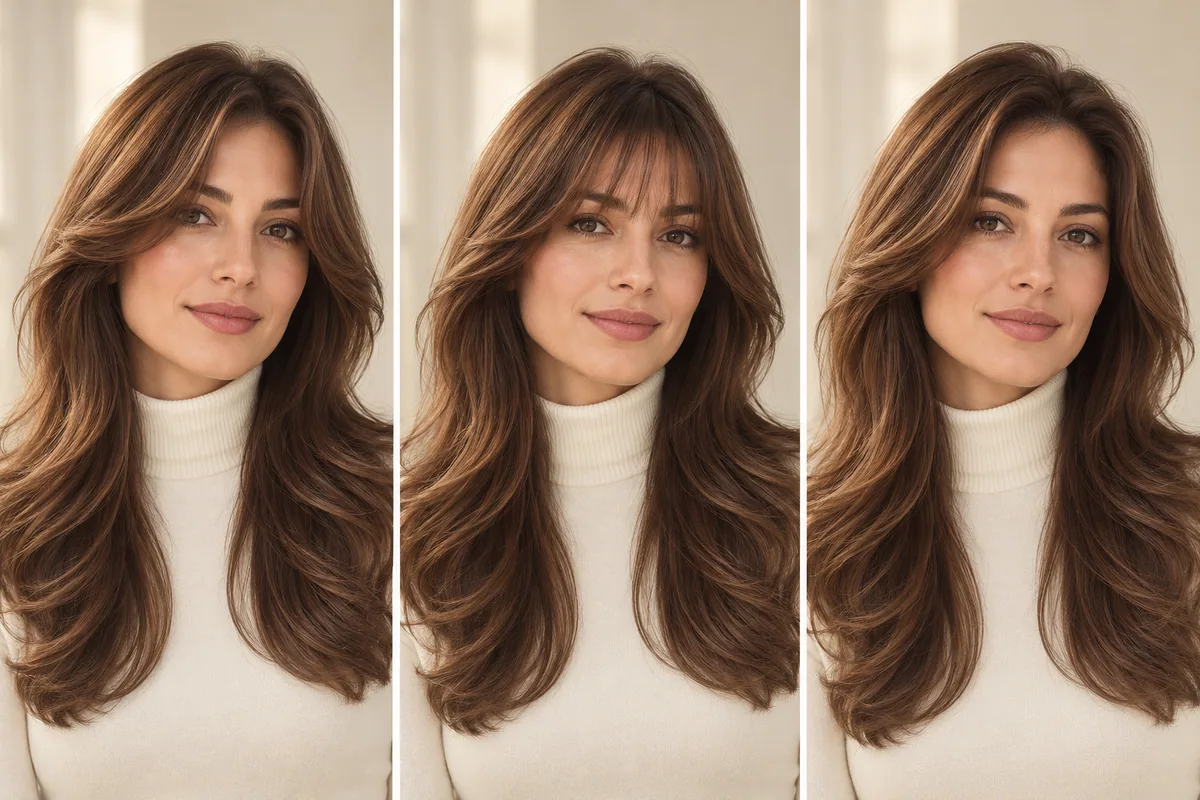
A butterfly haircut with bangs combines two choices: the layered outline and the hair that sits across or beside your forehead. Curtain bangs can connect the front to the longer layers; wispy bangs can make the forehead fringe a separate feature. You can also choose a butterfly-inspired cut without short bangs.
The easiest mistake is saving a picture because you love the sweeping layers, then realizing at the appointment that you never decided whether you wanted the fringe. Choose those parts separately. You may want almost everything in the photograph except the shortest section.
Keep the cut steady while you compare the front
Start with references at a similar overall length and color. If one has long, softly arranged layers and another has a much shorter cut, you are judging more than the bangs. Try to find three pictures where the main difference is at the forehead.
L'Oréal Paris's butterfly haircut overview treats bangs as an optional choice and includes curtain-fringe variations. That leaves room for a personal decision; the layered shape does not oblige you to copy one particular front.
In the illustration above, the three fronts are editorial possibilities. They are not evidence that one person's hair will produce all three versions, or that a certain bang option will behave the same way on your own hair.
What do you want to see at the forehead?
Look at your reference with the longer hair covered. Do you prefer a central opening, a light veil of shorter pieces, or an unobstructed forehead? Then look at it with your hair tied back. If those front pieces were the only obvious part of the haircut left visible, would you still choose them?
This is a useful exercise because a fringe can feel like a small detail in a full, long hairstyle. In an updo or ponytail, it can become the main feature. Take that everyday version seriously if you often wear your hair up.
On a small screen, swipe the table to compare every column.
| Front direction | The visual choice | A practical question |
|---|---|---|
| Curtain fringe | A parted opening with pieces extending outward | Where should the shortest pieces end when worn normally? |
| Wispy fringe | Light-looking coverage across some of the forehead | How much coverage do I want, and how should it join the sides? |
| No short fringe | Longer framing with more forehead visible | What is the shortest front length I want to keep? |
Do not read the table as a maintenance ranking. The work involved depends on your hair, the cut and the finish you choose. A light-looking fringe can still need attention, and a longer one can still get in your way.
Curtain bangs: decide on the opening and endpoint
With curtain bangs, study the open area in the center and the length beside the face. Two references can share the label while one ends near the cheekbones and the other reaches toward the chin. They will not make the same statement when the rest of the hair is pulled back.
Try marking the point you want the shortest piece to reach on a photo of yourself. Use it as a discussion aid, not a measurement for cutting. A stylist can help translate the visible endpoint into the right plan for your starting hair.
Read the long curtain-bangs length guide if the main uncertainty is how long the fringe should be. If you wear your hair off-center, the side-part curtain-bangs article addresses that separate question.
Wispy bangs: choose the coverage, not just the adjective
“Wispy” can describe a light appearance without saying exactly how much forehead is covered. Look for the gaps between the pieces, the length at the center and the way the edge meets the longer side sections. Those features are easier to discuss than asking for an unspecified amount of airiness.
Decide whether you want the fringe to feel distinct from the butterfly layers or to blend gradually toward them. A short center with much longer side pieces may be exactly what attracts you. It may also be the detail you did not notice until you looked closely.
For a closer comparison of the fringe categories themselves, use curtain bangs versus wispy bangs. This guide keeps the focus on how either choice sits within the same layered direction.
No fringe: explain the front length you want to keep
A butterfly-inspired cut without bangs can still have obvious movement beside the cheeks and jaw. The useful distinction is whether you want short hair entering the forehead area or longer pieces that form a frame beside it.
Instead of saying only “no bangs,” identify your minimum front length. You might want those pieces to sit below the jaw, remain easy to tuck or reach your usual hair tie. Demonstrate the action that matters rather than assuming every long front piece will do it.
If you are unsure whether the reference shows bangs at all, our bangs and face-framing layers comparison helps untangle the overlap. There is no need to argue over the label if you and the stylist agree on the intended shape.
Compare the version you will wear most often
Make two notes beside your favorite reference: what you like about the cut, and what you like about the styling. Perhaps the fringe appeals because it is lifted and curved away from the face. Perhaps it is the small opening in the center. Those are different preferences.
Find a second reference with a less arranged finish. If you cannot find one, ask the stylist how they expect the front to sit with your usual routine. Be specific about whether you enjoy using heat, arranging the fringe separately or simply letting it settle.
Your glasses, work requirements and comfort around the eyes can also change the choice. Wear your normal frames when comparing the front. The most useful reference is one that helps you explain how you want the hair to look in your own life.
Try the fringe direction in Hair Magic
Begin with a clear photo and a supported medium or long layered hairstyle. Explore the available bang and front-detail choices for that style. Controls vary, so use the nearest supported direction rather than assuming there is a named butterfly-with-wispy-bangs preset.
Keep the color and overall length similar as you compare. Tap Generate when ready; the photo is uploaded for cloud processing and an internet connection is required. Review each preview beside your original. The bangs filter guide walks through the process.
Ask yourself one question per result. Do I want the center this open? Are the shortest pieces near the endpoint I had in mind? Would I still like this front when the longer hair is secured? A preview can help you choose an appearance. It cannot establish how a fringe will separate, how a cowlick will settle or how long the styling will last.
Hair Magic is free to download with in-app purchases, and current preview access is shown in the app. Save a result if it communicates the front clearly; you do not need to endorse every generated strand.
Take one choice and one fallback to the salon
Write a primary request and a simpler alternative. For example, a fictional request might be: “I want the layered outline in this picture with a longer parted fringe. If the shortest front pieces would interfere with how I wear my hair up, keep the front longer and show me a more gradual connection.”
Your fallback is not a prediction that the first choice will fail. It tells the stylist which preference matters most if the reference needs adapting.
Put the selected style and practical notes in a Salon Card. Before the haircut begins, confirm the shortest front point, the center coverage and the connection into the longer layers. That is the part of the decision that “butterfly with bangs” alone cannot settle.
About this guidance. Published by Hair Magic, the app discussed here. Product details are based on the Hair Magic App Store listing, checked on 1 November 2026. This is planning guidance, not a professional assessment of your hair. AI previews are visual estimates; features and prices may change.
Read our editorial approach or explore all journal articles.