
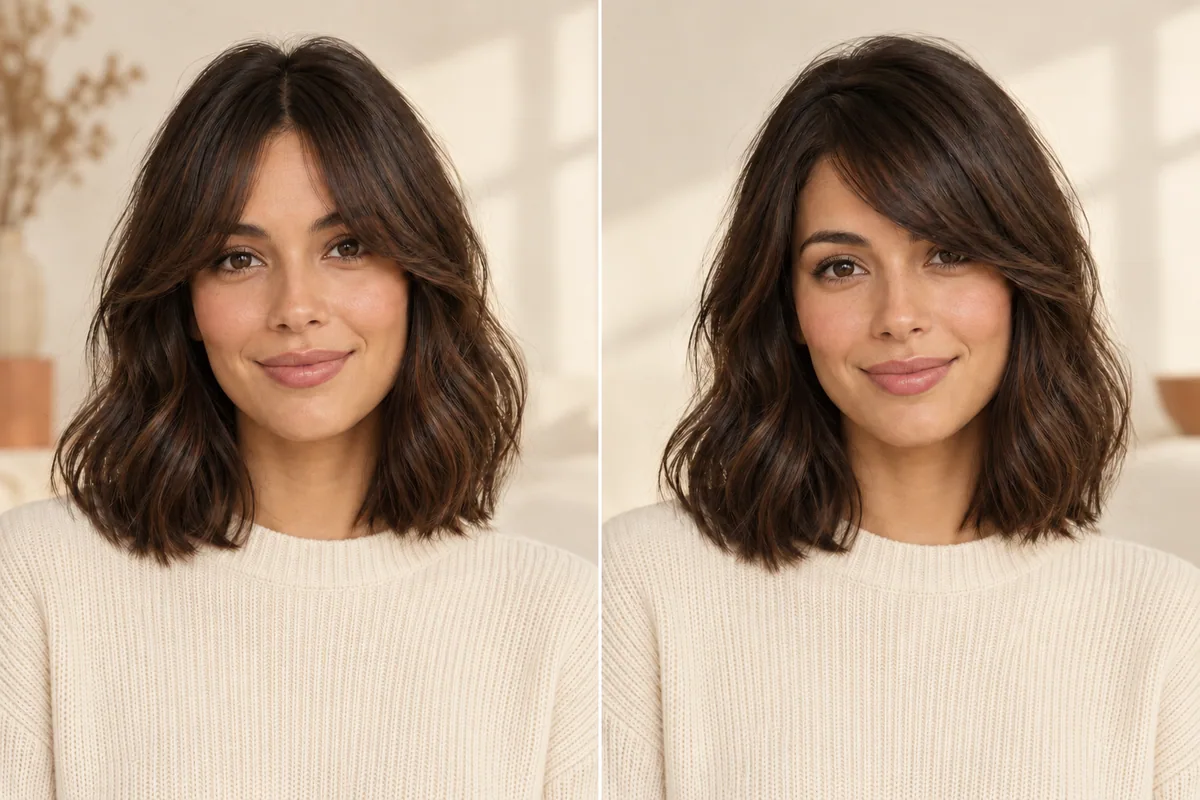
Curtain bangs usually separate into two sections that frame an opening. Side-swept bangs travel mainly across the forehead toward one side. The distinction is the fringe's shape and direction, not simply where the scalp part sits: you can wear a curtain fringe with a side part and still keep an opening between the front pieces.
To choose between them, look at the route the hair takes around your eyes. Would you enjoy a split frame, a diagonal sweep, or something between the two? Keep the rest of the haircut out of the comparison until you know which front you prefer.
Follow the hair across the forehead
Hair.com's guide to bangs distinguishes a curtain arrangement that frames both sides from a side-swept shape that moves from the chosen part toward the opposite side. These descriptions give you a starting point, but a reference photograph still needs a closer look.
Cover the lengths below the chin in your saved picture. Then trace the fringe with your finger. With an open curtain effect, your eye follows two paths away from the gap. With a side sweep, the stronger path crosses the front in one direction. A few loose strands do not erase that difference.
The illustration above keeps the comparison focused on these two arrangements. It is generated editorial artwork, not a demonstration that the same real haircut can be changed between them with one brush stroke.
If you already have bangs, moving them to one side can help you explore a preference, but it does not prove that a new cut is necessary. A stylist can explain whether the desired change is mostly arranging the existing length or changing the shape.
A side part does not settle the question
Imagine an off-center part through the top of the head, with the fringe opening closer to the middle. Now imagine the same scalp part with hair sweeping across much of the forehead. The part is similar; the visible front is different.
That is why “I want a side part” can leave a fringe request unfinished. Show where you want the top parted and where you want open space around the forehead. They are two related choices rather than one instruction.
Our curtain bangs with a side part article focuses on keeping a curtain-style opening while changing the part. If that is the look you want, you may not need a separate side-swept fringe at all. The middle part versus side part comparison covers the broader hairstyle decision.
Also mention whether you often change sides. A fringe designed around one direction may look different when moved the other way. Ask the stylist to show what flexibility the proposed cut would retain.
Fill in an eye-and-glasses worksheet
Take a straight-on photo with your head level. Wear your everyday glasses if you use them. You can make notes on the photo or copy the short worksheet below into your phone. These are preferences to discuss, not measurements for cutting your own hair.
On a small screen, swipe the table to compare every column.
| Area | Write down what you want visible | Check in each reference |
|---|---|---|
| Center of the forehead | Mostly open, partly covered, or crossed by a sweep | Does the picture actually show that amount of space? |
| Left eye and brow | Clear, lightly framed, or partly covered | Where is the shortest piece on this side? |
| Right eye and brow | Clear, lightly framed, or partly covered | Does the heavier side reach the eye? |
| Upper glasses rim | Visible or partly overlapped | Would the fringe meet the frames? |
| Temples | Loose pieces or hair that can move back | Which pieces need to tuck? |
You do not have to make the two eye areas match. Some people enjoy a more open side and a heavier sweep on the other. Others like the appearance but would find hair near one eye distracting. The worksheet helps you distinguish those reactions before cutting.
For a specific example, write: “I like the diagonal sweep, but I want my right eye clear without repeatedly pushing the hair away.” That gives the stylist a problem to solve. “Side bangs, but easy” leaves the important detail unstated.
The guide to hairstyles with glasses expands the frame checks. If glasses are optional for you, look at both versions rather than deciding from only the more dressed-up one.
Compare the shortest point, not just the longest edge
A long sweeping edge can hide a much shorter section underneath or near the part. Before agreeing to a side fringe, ask the stylist to identify the shortest proposed piece and its dry position.
Do the same with curtain bangs. A reference can have long side pieces while still showing a substantial change near the middle. Looking only at the cheek-framing ends can make the haircut seem less of a commitment than you intended.
Write down any length you need to preserve for tucking, clipping or tying back. Demonstrate the action at the appointment. Whether the piece reaches depends on more than the style name, so a generic promise that long bangs always tuck is not enough.
If you mainly want shorter pieces beside the face while leaving the forehead open, bangs versus face-framing layers may be the more useful next comparison. Keep that option available instead of forcing a fringe choice you do not really want.
Watch what your current front does when you stop arranging it
Which way does your front usually go? Notice it after you have been working, walking or wearing headphones. You do not need to diagnose a growth pattern. Simply record where it opens and which sections you keep moving.
Take those observations to the stylist. If you want a sweep opposite to your usual direction, ask what the change would require on an ordinary morning. If you want a more even opening than you naturally get, ask how the proposed length would affect that effort.
Texture belongs in this discussion too. A smooth reference may show a continuous diagonal line, while your usual wave or curl could break the shape into smaller sections. Show your hair in the finish you wear most often and identify which part of the inspiration you like.
For curls, the curly curtain bangs guide helps you discuss dry length and the opening. You can prefer a general direction without asking individual curls to behave like straight strands in a photograph.
Compare the appearance on your own photo
Hair Magic can help you picture a supported fringe direction before the salon discussion. On your iPhone, choose or take a clear photo and browse the bangs styles. Look for available choices close to an open fringe and a side-swept front. Check which parting or bangs details each selected hairstyle offers; the controls vary.
Use the same starting photo and keep your color unchanged. Where possible, compare similar overall lengths. If one result also changes the cut around the jaw or adds a different texture, separate those changes from your opinion of the fringe.
When ready, tap Generate. Your photo is uploaded for cloud processing, and an internet connection is required. Review the result beside the original, then return to the worksheet: opening, eye areas, frames and temples. Save a useful preview if it explains your preference more clearly.
The bangs preview guide covers the workflow. Hair Magic is free to download with in-app purchases; generation access is shown in the app. A preview cannot identify a cowlick, predict which direction your hair will settle or confirm that a section will stay tucked.
Two useful requests to take to the salon
For an open frame, you could say: “I want an opening between the front pieces, even with my usual side part. I like this amount of forehead showing and want the sides to connect into the rest of the cut. Please show me the shortest piece in its dry position.”
For a sweep, try: “I like the front travelling in this direction, but I need this eye and the top of my glasses clear. I usually wear my hair this way, and I want to know what arranging the sweep would involve.”
Add the reference image and any tucking requirement to your Salon Card or appointment notes. You have given the stylist a visible opening and a practical limit to work with, which is more precise than choosing a name alone.
About this guidance. Published by Hair Magic, the app discussed here. Product details are based on the Hair Magic App Store listing, checked on 18 October 2026. This is planning guidance, not a professional assessment of your hair. AI previews are visual estimates; features and prices may change.
Read our editorial approach or explore all journal articles.