
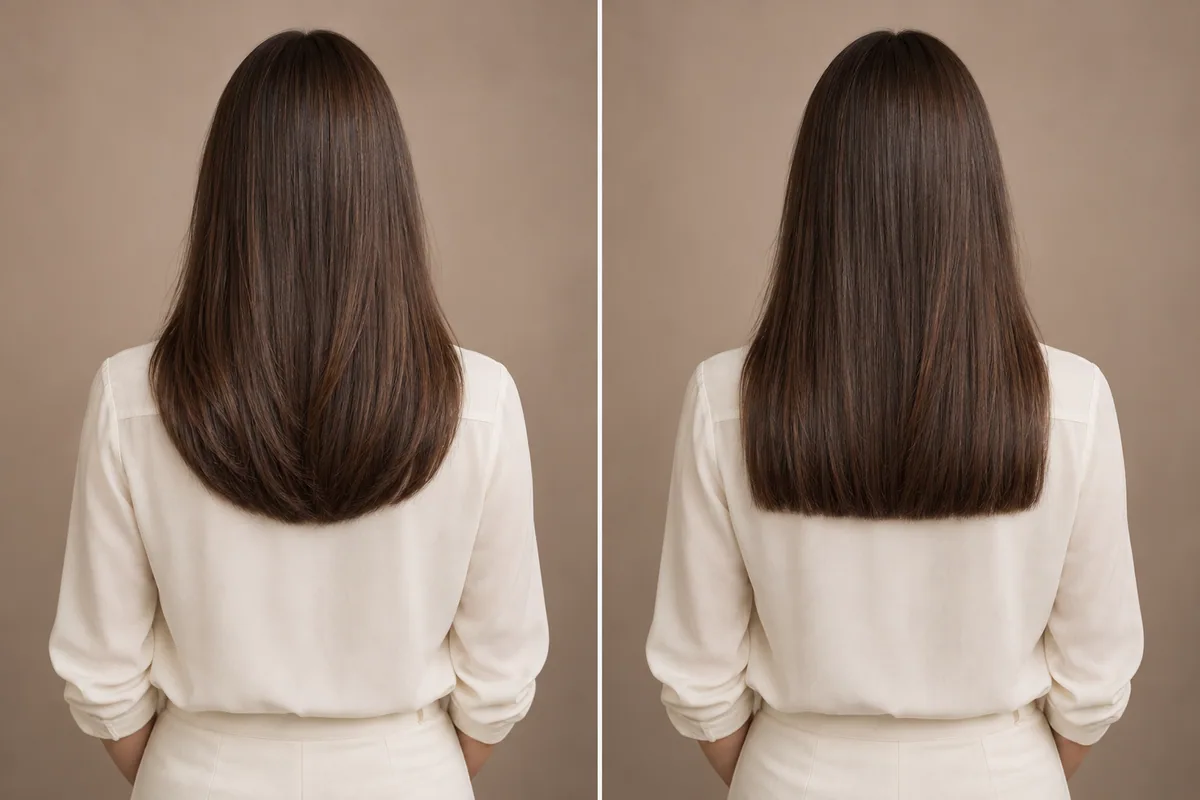
A U-cut has a rounded lower outline when you look at the hair from behind: the center hangs lower than the outer edges. A straight cut, in this comparison, means a straighter line across that lower outline. It does not mean straightening the texture, and it does not automatically mean having no layers.
The most useful question is how much length you want to keep at the sides relative to the center. Both versions can keep a long center section, yet feel quite different when you bring the hair forward or gather it into a braid. Start with a back reference; a beautiful front photo will leave the main decision unanswered.
Compare the outline before the styling
Hair.com's guide to U-shaped cuts includes an explanation from L'Oréal Professionnel artist Madison Sullivan: the shorter sides create the rounded U outline. The article also shows that the curve can be shallow or more pronounced. There is no single U shape you must choose.
In a reference photo, follow the very bottom edge from one side to the other. Ignore the highlights and styled bends for a moment. Does the line turn gradually downward toward the middle, or travel more directly across? That is the part of the image you are comparing here.
For a fair comparison, choose pictures with a similar center length and finish. A waist-length U-cut next to a shoulder-length straight cut mostly tells you whether you like long hair. It does not isolate the perimeter. Likewise, a curled edge can make it hard to tell how the underlying outline was cut.
On a small screen, swipe the table to compare every column.
| Decision | U-shaped outline | Straight-across outline | What to show the stylist |
|---|---|---|---|
| Shape from behind | A rounded line with shorter outer edges | A straighter lower line | A clear back photo with the curve or line marked |
| Side length | The difference from the center is part of the choice | The desired baseline is the starting point | Where you want the outer sections to finish |
| Internal layers | Must be agreed separately | Must be agreed separately | The interior movement you do or do not want |
| Hair brought forward | Inspect how the shorter outer lengths sit | Inspect the front view rather than assuming it matches the back | A second photo with hair over both shoulders |
| Braids and ponytails | Assess the sections that need to stay together | Assess the same sections; the label is no guarantee | Your actual braid or tie position |
If the pointed alternative is what caught your eye, use our U-shaped versus V-shaped haircut guide instead. That comparison involves a different back outline.
Decide what “keep my length” means
“Keep the length” can mean keep the longest tip, keep the amount of hair at the sides, or preserve the impression of a broad lower edge. Say which one you mean. Otherwise, you could retain the center length and still feel that too much has changed around the rest of the outline.
Here is a simple reference exercise. On a current back photo, mark the longest point you hope to retain. Then mark the outer ends you do not want shortened beyond a certain point. Ask the stylist whether the desired curve can fit between those boundaries with your current hair.
Do not try to calculate the cut from the photo. Shoulder position, head tilt and the way the hair was arranged all affect the apparent line. The marks communicate a preference; the stylist needs to assess the real hair in front of them.
If you already have a U and want a straighter edge, ask which sections would determine the new baseline. You may be choosing between losing some center length now and waiting for the shorter outer areas to grow. Have that conversation before agreeing to “just a trim.”
A fuller-looking edge is not more hair
A reference may appeal because its bottom edge looks broad and substantial. That appearance is worth naming, but it does not establish the model's density or predict your result. Lighting, finish, extensions and how the hair is spread can all make photo comparisons misleading.
Tell the stylist, “I like the amount of hair visible along this bottom edge,” then ask what is realistic with your current lengths. Avoid choosing a U because it is said to add volume, or a straight edge because it is said to guarantee thickness. Those phrases skip the individual assessment you need.
The outline and interior are also different requests. You might want a gentle U with little additional layering, or a straight baseline with movement above it. Our blunt cut versus layered hair article explains how to keep those questions separate during a consultation.
Check the view you actually wear
If you mostly wear your hair in front of your shoulders, take a second reference photo in that position. Notice whether you enjoy the shorter outer pieces once they sit beside your chest. Then put the hair behind your shoulders again. Neither view should be a surprise after the haircut.
For waves or curls, discuss the outline in the finish you wear most. A smooth geometric line in a reference is not a promise that your dry ends will form the same line every day. Ask what the proposed shape would look like in your normal texture, and whether the reference relies on styling you rarely do.
Bring your usual accessory if you often braid or tie your hair. Show where the front and side sections need to join the rest. “I need these pieces to stay in this braid” gives the stylist more useful information than “I need it long enough.”
Three requests that lead to different consultations
A small change to long, mostly one-length hair: “I want a shallow curve at the bottom rather than a clear point. Please keep as much side length as possible, and show me how the front will sit when I bring it forward. I am not asking for shorter layers throughout.”
A straighter outline after a previous U-cut: “I prefer this level-looking lower edge now. Please show me how much center length would need to come off to approach it. If that is more than I want to lose, let's agree on an intermediate trim.”
A rounded outline with a braid requirement: “I like the softer back edge, but this side braid is part of my daily routine. These sections need to remain together. Can you assess how shallow the curve should be to preserve that?”
These are hypothetical briefs you can adapt. They are not reports of salon results, and the illustrations on this page are not proof of how a particular person's hair would behave.
Save a back reference and a front reference separately
Give each image one job. Label the back picture “perimeter” and note how pronounced you want the curve. Label the front picture “framing” and mark the shortest pieces you like. Keep your current photos with both.
Hair Magic can help with the related front-facing choice: take or select a photo, browse a supported longer hairstyle, and retain your current color while comparing the broad shape. Available length and layer details vary by selected style. Tap Generate when ready; this uploads the photo for cloud processing and requires internet.
A front-facing AI result cannot show whether the back perimeter should be curved or straight. Keep your separate back reference even if you love the preview. Use the Salon Card guide to organize the selected style and practical notes, and add your perimeter request alongside it.
Before the scissors come out, confirm three things aloud: the longest point, the amount of side length being removed and whether any internal layers are changing. That short conversation is more useful than assuming you and the stylist mean exactly the same thing by “U-cut.”
About this guidance. Published by Hair Magic, the app discussed here. Product details are based on the Hair Magic App Store listing, checked on 1 October 2026. This is planning guidance, not a professional assessment of your hair. AI previews are visual estimates; features and prices may change.
Read our editorial approach or explore all journal articles.