
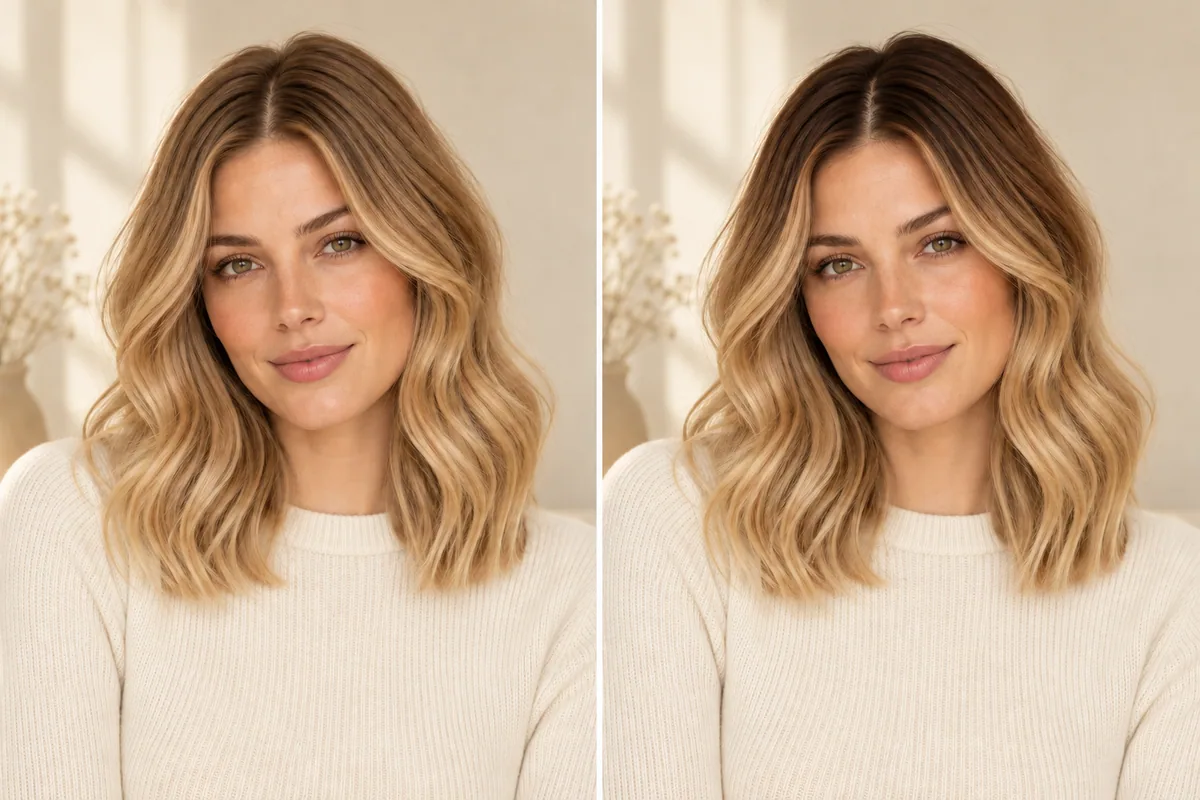
Root shadow and root smudge are overlapping salon terms for a darker root area blended into the surrounding color. Some colorists use “smudge” for a subtler difference and “shadow” more broadly, but the names do not guarantee two distinct results. In a root shadow vs. root smudge decision, compare how dark the roots look, how far that depth appears to extend and how gently it meets the lengths.
Those visible details are easier to agree on than a label. You can ask for a soft transition without asking for a nearly invisible root, or enjoy a pronounced dark root while still wanting the edge to look blended.
Why the two names can describe similar hair
Wella Professionals notes that some colorists use root shadow and root smudge interchangeably. Its explanation allows “smudge” to describe a root color closer to the mid-lengths, while “shadow” can cover a wider range of contrast. This is useful context, not a universal rule for every salon menu.
If two saved photos use different names but show the same effect, you do not need to sort out which caption is correct. Identify the common feature you like. It might be a small amount of depth at the part, a darker crown or a gradual change into brighter ends.
At the appointment, ask what your colorist means by the service name. Then show the reference. A brief confirmation—“I mean this amount of darkness and this kind of transition”—can resolve more than a long discussion about terminology.
Read the reference in three parts
Start with the root area, then follow one section of hair toward the ends. Do this in more than one place, because the front may look brighter than the crown or the hair underneath.
On a small screen, swipe the table to compare every column.
| Detail | What to compare | A useful way to describe your preference |
|---|---|---|
| Root depth | How dark the area near the scalp appears | “I like the depth in my current roots.” |
| Extent of the darker area | Where the lighter impression starts to become noticeable | “I want brightness to remain close to the face.” |
| Transition | Whether the change looks gradual or sharply defined | “I want a visible darker root with a soft edge.” |
Treat these as separate choices. A very dark root does not have to have a hard boundary, and a small difference in color does not automatically make the placement right for you.
The illustration above compares a softer, lower-contrast appearance with a stronger dark-root contrast. Both are generated concepts. They are not photographs proving two different salon techniques, and their placement is not a measured plan for your hair.
Keep the brighter lengths in view
A common reference-photo problem is liking the roots in one picture and the ends in another without noticing that the overall balance differs. A large darker area can leave less of the visible hairstyle looking bright. If keeping that brightness matters, say where you want it to begin.
Imagine two requests. The first is “I want the roots a little deeper, but I love the light pieces beside my face.” The second is “I want a darker overall frame, with brightness mostly through the lower lengths.” Both could appear in a shadow-root search. They would not communicate the same goal to your colorist.
Choose a front view as well as a view of the part or crown. A back-only photo can show a beautiful transition while leaving the feature you care most about—the color next to your face—unanswered.
If tone is also part of the decision, describe it separately. The hair color planning guide can help you distinguish a request for cooler roots from one for darker roots. You may want both, but it is helpful to know which change matters more.
Root shadow, highlights and balayage can be part of one look
The root area and the lighter pattern through the lengths are different parts of the photograph. You might enjoy the bright ribbons in a highlighted reference as well as the depth at the top. There is no need to describe the whole result with just one of those features.
Wella's dark-hair color guide describes a salon service that combines balayage and a root shadow. The relevant point for your consultation is that these appearances can coexist. Your colorist can explain which service or combination would address the picture you bring.
Use the balayage, highlights and ombré comparison if you are unsure which pattern catches your eye. Save a separate placement reference when necessary. “The root depth from this photo and the lighter ribbons from that one” is clearer than assuming a service name includes every detail.
You can also explore a broad dimensional direction with the balayage try-on guide. A photo preview may help express the balance you like, but it cannot select or reproduce a colorist's exact placement.
A darker-looking root is not a maintenance schedule
The appeal of a rooted reference may be that it looks relaxed as well as polished. That does not establish how much work it would take to keep the same appearance on you. Start by asking whether the proposed root color is close to the color that naturally grows from your scalp.
Then ask which part of the finished look might need refreshing: the root tone, the transition, the brightness through the lengths or something else. You may have different priorities for each. For example, you might be happy to let the darker area become more visible while wanting to keep the lighter pieces at the front.
If gray coverage is part of the request, state it separately. The phrase “root shadow” does not tell your colorist how much gray you want left visible. Our gray blending vs. full coverage article will help you put that preference into words.
Bring a current photo and explain previous color services as accurately as you can. Ask for an appointment and care plan based on your starting hair, not a universal promise that a root smudge is low maintenance.
Try a root-shadow direction on your own photo
Hair Magic includes root shadow among its color directions. On iPhone, select a clear photo, keep your current hairstyle and choose the root-shadow option to explore the broad appearance. Available details depend on the look you select; the app is not a placement brush or a salon-formula selector.
After reviewing the selection, tap Generate. Your photo uploads for cloud AI processing, which needs an internet connection. Compare the result with the original and look at the relationship between the root area and the lengths. Note where the preview agrees with your reference and where it differs.
If it shows more darkness than you want near the face, that is useful information to record. Do not assume that you must accept every feature in a generated image because you like one part. The hair color changer guide explains the comparison and saving options.
Hair Magic is free to download with in-app purchases; check current generation access in the app. You can optionally save a preview and create a Salon Card with the chosen direction and practical notes. The image helps communicate an appearance, not a guaranteed dye result.
Take one annotated reference to the consultation
Choose your clearest image and write three notes beside it: keep, change and ask. For example:
- Keep: “I like the brightness through the lower lengths.”
- Change: “I want less darkness beside my forehead than this reference shows.”
- Ask: “Could the root area stay close to my natural color, and what would maintaining the lighter pieces involve?”
For a stronger contrast, the notes might instead say that you want a noticeably darker crown and a gradual transition. The structure stays useful because it describes the photograph rather than trying to prescribe a technique.
Read the notes back with your colorist before the service. You may agree to call the result a smudge, a shadow or something else on that salon's menu. What matters is that you both mean the same depth, the same visible brightness and the same kind of blend.
About this guidance. Published by Hair Magic, the app discussed here. Product details are based on the Hair Magic App Store listing, checked on 18 October 2026. This is planning guidance, not a professional assessment of your hair. AI previews are visual estimates; features and prices may change.
Read our editorial approach or explore all journal articles.