
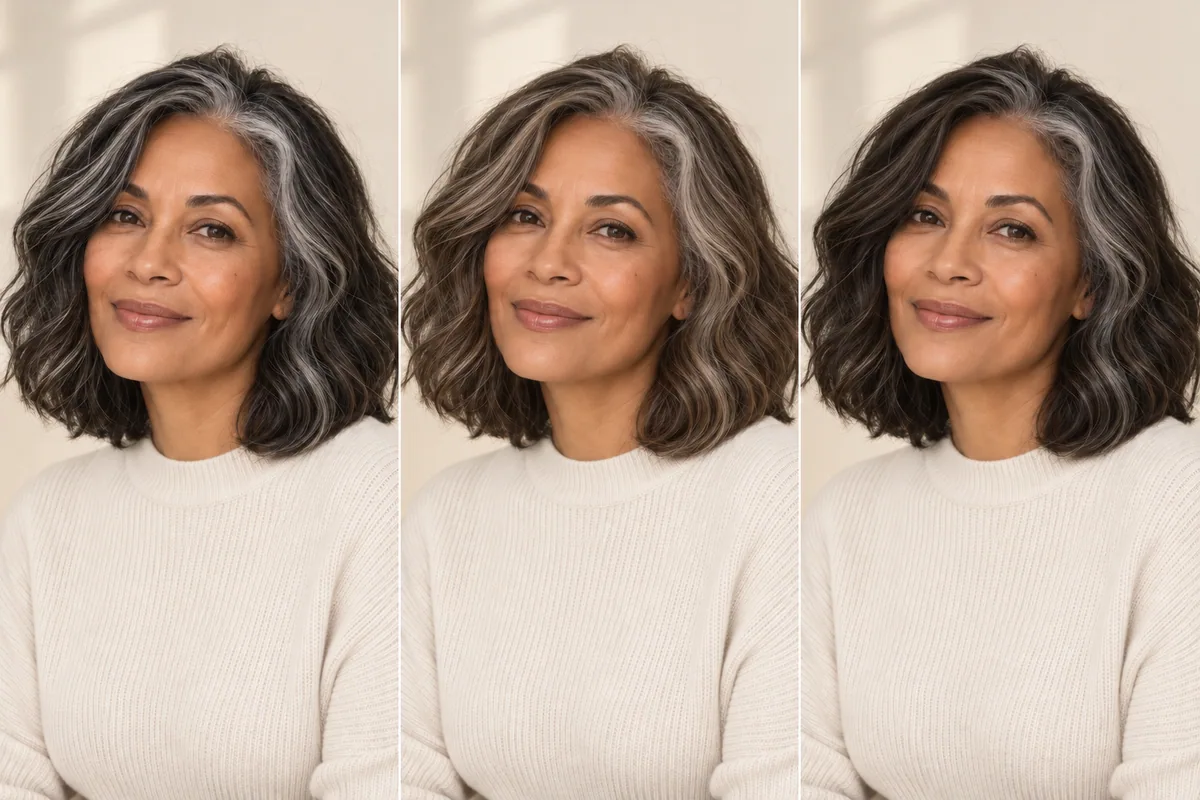
Gray blending on dark hair is a decision about the relationship between your lighter strands and the darker hair around them. Highlights introduce lighter sections; lowlights introduce darker ones. Either may be part of a salon plan, but they do different visual jobs. Start by deciding whether you want a lighter overall impression, more visible brown depth or simply a less abrupt contrast in one area.
You can keep a brunette appearance while allowing gray to remain visible. You can also choose to emphasize a silver section you like. “Blended” does not have to mean that every strand disappears into one uniform color.
What would you like the blend to change?
Look at your current hair with your usual parting. Finish this sentence without naming a treatment: “I would like the difference between these areas to look…” Perhaps your answer is softer, more deliberate, brighter around the face or closer to the brown through the lengths.
That answer helps separate three requests that are easy to confuse. You might want the gray to remain visible but feel more connected to the rest. You might want a lighter mixture throughout. Or you might want the gray covered as completely as possible. The last request belongs in a blending-versus-full-coverage conversation, even if your inspiration photo was captioned “gray blending.”
Bring the goal to your colorist before settling on highlights or lowlights. The same word can mean “keep my brunette depth” to one person and “help me move toward silver” to another.
Highlights and lowlights change the comparison in different ways
Wella Professionals' guide to gray on dark hair describes highlights as one blending option and lowlights as darker strands that add depth and dimension. Those are useful appearance distinctions. They do not tell you which service your own hair needs.
On a small screen, swipe the table to compare every column.
| If the reference appeals because… | Notice this in a lighter-section reference | Notice this in a darker-section reference |
|---|---|---|
| You want a brighter overall appearance | How much of the dark base remains between the lighter pieces | Whether the added depth would move away from the brightness you want |
| You want to keep looking brunette | Whether you still recognize the overall brown impression | Where the darker strands create the depth you want to preserve |
| You like your visible silver | Whether the lighter pieces sit beside or compete with that feature | Whether a darker background makes the silver more distinct |
| You mainly dislike a contrast at the roots | How the lighter lengths relate to the new growth | How the proposed darker areas would relate to future visible growth |
The table is a way to read references, not a prescription. You may find that the feature you like comes from a combination of lighter and darker areas. Show that mixture instead of assuming you must choose one technique for the whole head.
The three portraits above are generated illustrations of different contrast ideas. They do not show a real person's color service or establish which strands would take color. Use them to name a preference, then bring a current photo of your own hair to the consultation.
Make a three-area map of your current hair
You do not need to estimate a percentage of gray. A simple map of where you notice it is more helpful for explaining the decision.
At the part: Look with the hair arranged as you normally wear it. Describe whether you see a fine scattering, a concentrated section or a clear boundary against older color. Keep those observations separate; they may be different concerns.
At the temples and hairline: Check the hair both loose and pulled back. If you like a light section here, say so before asking for an overall blend. A request to soften contrast everywhere might otherwise overlook the one feature you want to keep distinct.
Through the lengths: Notice whether the ends look different from the roots or mid-lengths. You might be comfortable with the new gray but unhappy with an older dark band. Explain that directly rather than describing all the gray as the problem.
Write one sentence for each area. For example: “I like the silver at my temple; I want the part to feel less separate from the lengths; I want to keep most of the lower hair brown.” That is already a useful brief.
Choose your preferred amount of visible variation
A small amount of contrast can look softly mixed. Larger light and dark sections can make the variation itself a feature. Neither preference requires an age rule or a promise to eventually become fully silver.
Look at your references from a normal mirror distance as well as close up. A finely detailed photograph may show beautiful individual strands, yet its overall appearance may be much lighter than you want. Conversely, a dark overall reference may contain more visible silver than you first noticed.
If you are choosing between a distinct mixture and a predominantly pale gray appearance, see salt-and-pepper vs. silver hair. For this appointment, mark the parts of each picture you would keep. A reference can be useful even when you only want its front section or its amount of dark color underneath.
Bring a grow-out reference as well as a finished look
A freshly styled result cannot show every stage between appointments. If you have photos of your own hair a few weeks apart, bring them in date order. Point out when you still enjoyed the appearance and when you began wanting a change.
You might discover that the root line bothers you before the overall tone does, or that you are comfortable with visible growth as long as the ends remain close to the color you like. Those observations help make the maintenance discussion personal.
Ask what the proposed plan would be expected to look like between visits, which areas might need attention, and whether it can be adjusted in stages. No article can assign a dependable appointment schedule from the phrase “gray blending on dark brown hair” alone. Your starting color, previous services and preferred appearance belong in that discussion.
Keep a record of the coloring you remember, including home products. It is fine not to know every formula. A current photo and an honest history are more useful than a guessed technical description. The salon conversation checklist can help you organize what to bring.
Compare the color direction without changing the haircut
Hair Magic offers gray blending, highlights and lowlights among its color directions. On your iPhone, select a clear current photo and keep your current hairstyle so the comparison stays focused on color. Start with the direction closest to your goal; you do not have to explore all three.
Review the selected look and tap Generate. Your photo is uploaded for cloud AI processing, which requires internet access. Compare the result with your original, first at normal viewing size. Ask whether you like the broad balance of light and dark before studying the small invented details.
A preview cannot map your exact gray distribution, prove coverage or choose a salon method. If it moves a silver section you want to preserve, write that down beside the image. Use the gray hair try-on guide for the workflow, or the hair color changer guide if you are comparing a different color direction too.
Hair Magic is free to download with in-app purchases. Check the app for your current generation access. You can optionally save or export a useful preview and create a Salon Card with the selected style, color and practical notes.
Three clearer requests than “just blend the gray”
Keep the brunette depth: “I want to keep the overall dark-brown appearance. I am comfortable seeing some silver, but I want to understand the options for connecting it with the darker lengths. I do not want to become much lighter everywhere.”
Keep a silver feature: “I like the light section at my temple and want it to stay noticeable. The contrast through the rest feels less intentional to me. Can we discuss the surrounding color without losing that front section?”
Explore more lightness: “I like the lighter mixture in this reference. I would like to discuss a gradual change from my current dark color, including an intermediate appearance I could comfortably wear.”
Choose the request closest to yours and add the one thing you do not want changed. Your colorist can then explain which approach fits the actual hair in front of them. You arrive knowing what the blend should achieve, even if the final service is different from the one you first searched for.
About this guidance. Published by Hair Magic, the app discussed here. Product details are based on the Hair Magic App Store listing, checked on 18 October 2026. This is planning guidance, not a professional assessment of your hair. AI previews are visual estimates; features and prices may change.
Read our editorial approach or explore all journal articles.