
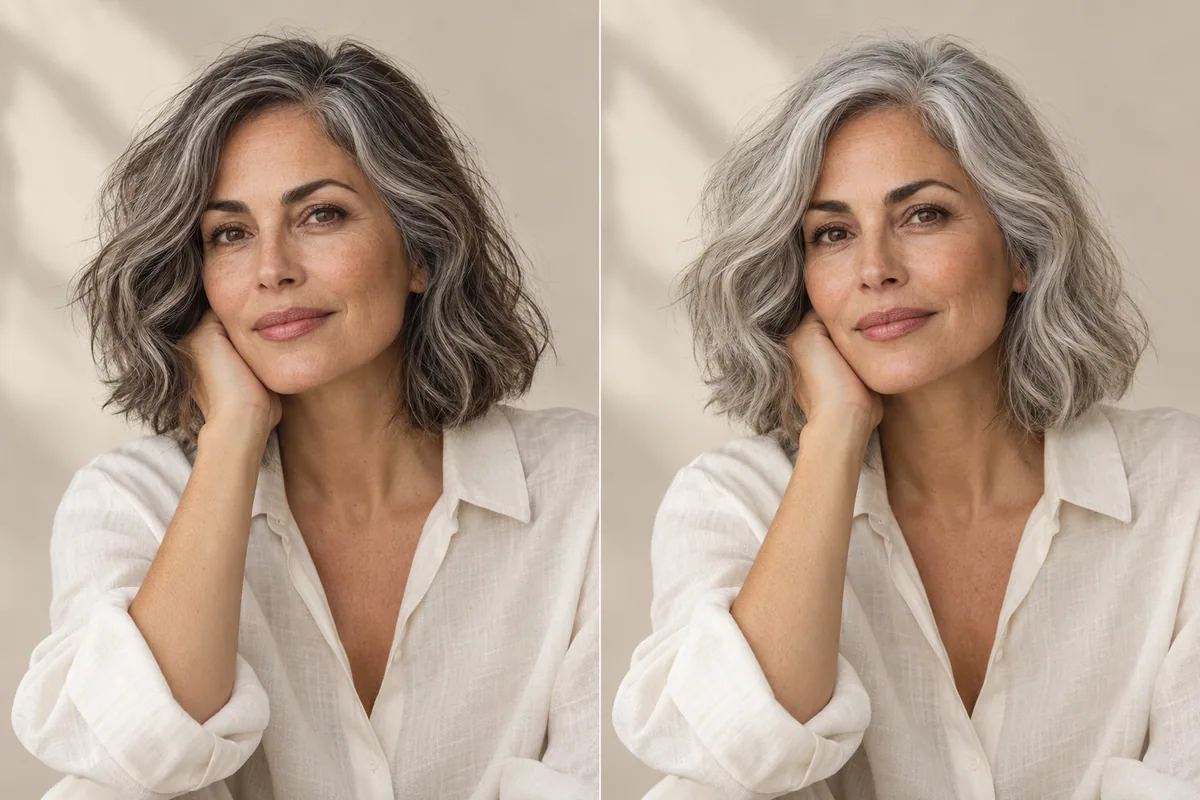
Salt-and-pepper hair has a visible mixture of darker and lighter strands; silver hair usually describes a predominantly pale, gray-toned appearance. The useful question is how much dark color you want to keep seeing. You might love a bright silver frame around your face while preferring darker variation through the rest of your hair.
Neither look is a required stage on the way to the other. You can enjoy your natural mixture, discuss a colored interpretation, or simply explore what a lighter gray direction might look like. Choosing the appearance and deciding how to reach it are separate conversations.
Look at the mixture, not just the name
Two photos labeled “silver” can look surprisingly different. One might show almost white hair with a faint cool cast. Another might have smoky roots and much darker strands underneath. A photo labeled “salt and pepper” could show a fine, even scattering or distinct light sections against a dark base.
Wella Professionals' guide to enhancing gray hair discusses adding darker lowlights to create a salt-and-pepper appearance. The darker parts can be an intentional feature of the finished look. A reference photo helps explain how much of that contrast you want to see.
Use this comparison to decide what you are actually drawn to:
On a small screen, swipe the table to compare every column.
| Feature to examine | Salt-and-pepper direction | Predominantly silver direction |
|---|---|---|
| Overall impression | An obvious light-and-dark mixture | A paler gray appearance across more of the hair |
| Dark areas | Part of the look you want to preserve or create | May be quieter, smaller or absent in your reference |
| Near the face | Can be dark, light or visibly mixed | Often reads as a lighter frame in the reference |
| Detail worth pointing out | The size and location of the contrasting areas | The desired lightness and any depth you still want |
| Question for your colorist | “How much of my existing dark color could remain visible?” | “How would this lighter appearance relate to my starting hair?” |
These are descriptions for choosing photographs, not fixed salon formulas. You do not need to count gray strands or assign yourself a percentage before you can have a useful opinion.
Start with the hair beside your face
Look at your references at roughly the size you would see yourself in a mirror. It is easy to become absorbed in a close-up of beautiful strands and miss how the whole head of hair feels to you.
First, cover the lower lengths of the image with your hand. Notice the hair at the temples, around the forehead and beside the cheeks. Is that where you want brightness? Or do you prefer the definition of a darker frame? Then uncover the rest and decide whether you like the same balance through the lengths.
Try looking with your usual glasses on. A silver frame, dark frame or translucent frame may be an important part of the appearance you are considering. You are checking your preference, not following a rule about which accessories “work” with gray hair. Our guide to hairstyles with glasses offers more questions if you are also changing the cut.
Notice your parting, too. A light section that is prominent with a side part may be less visible with the hair moved in another direction. Bring a reference showing how you normally wear your hair, rather than choosing from one carefully arranged view alone.
Natural gray and dyed silver are different plans
“I want to see more of my natural gray” and “I want this particular silver color” sound similar, but they can lead to different appointments. The first begins with the color already growing from your scalp. The second begins with a visual target that may not resemble your natural pattern.
For a natural-gray conversation, show your current roots, part and hairline. Explain whether the older colored lengths are what bother you, or whether you simply want advice about letting the new growth become more visible. A photograph of someone else's silver hair cannot tell you how your own distribution will develop.
For a dyed-silver conversation, show the exact reference and describe its lightness. Your colorist will need your color history and an assessment of your hair before discussing the process. Do not treat the pale result in an AI image as evidence that the same change is achievable in one visit.
If the real question is whether to blend or cover the gray you already have, use the separate gray blending vs. full coverage comparison. Here, the decision is the visible mixture you prefer. Blending and coverage are ways of discussing a service, and the same general appearance can involve very different starting points.
Choose which kind of variation you enjoy
Some references have a quiet, finely mixed appearance. Others have bolder streaks or a bright front section. Both may fall under salt and pepper, yet they can feel very different when you imagine wearing them.
Make a small reference board with just three images: one close to your current appearance, one with more visible lightness, and one with the strongest contrast you would consider. Keep the cut similar where possible. Otherwise, a dramatic new bob can distract you from the color choice.
Under each image, write what you would keep and what you would change. “Keep the darker underneath section; make the front less bright” is useful. “Nice gray” leaves the main decision unresolved. If you like a photograph only because the hair looks especially glossy or full, find another color reference before deciding.
The illustration at the top of this page is intended to make these visual differences easier to discuss. It is AI-generated, so its distribution and finish are invented. It is not a customer transformation, a measured comparison or a photograph of what a particular salon service produces.
Three requests you could take to a colorist
These are example briefs to adapt, not accounts of real clients. Each makes a different part of the decision clear.
Keep the mixture: “I like the dark color I still have and the lighter strands through it. I do not want everything to look uniformly pale. This reference shows the amount of contrast I enjoy. Could we talk about how to keep that character while the older color grows out?”
Explore a lighter overall appearance: “I am drawn to this predominantly silver reference. I like the brightness around the face, but I need to understand what getting closer to it would involve from my current color. Please show me an intermediate option if the full reference is not a sensible first step.”
Preserve one feature: “I like this light section near my hairline and want it to remain noticeable. I am less attached to the color through the ends. Can we build the plan around keeping that front section, with a transition I would be comfortable wearing?”
Add one practical boundary to your version: the length you want to keep, the appointment commitment you can manage, or how visible you are comfortable letting the transition become. That gives your colorist a clearer problem to solve than a color name on its own.
Try a gray direction on your own photo
Hair Magic can help you explore a broad color change on your iPhone before the consultation. For this decision, keep your current hairstyle and concentrate on the available color choices. Use the preview to compare the overall impression of lighter hair; keep photos of your own roots and gray pattern for the consultation.
- Choose a clear, current photo without a strong color filter. Keep it as the starting image for your comparisons.
- Browse the available gray or color directions, including gray blending where it matches what you want to explore. Use the closest supported option rather than assuming every reference name has its own preset.
- Review your selection and tap Generate. Your photo is uploaded for cloud AI processing, which requires internet access.
- Compare the result with the original. Ask whether you like the overall lightness before judging small details in the invented strand pattern.
- Optionally save or export a useful preview, then keep your real reference photos beside it.
The gray hair try-on guide explains the full workflow. Hair Magic is free to download with in-app purchases; check the generation access shown in the app. A preview can help express “more lightness” or “keep more depth,” but cannot forecast your natural gray or specify a dye formula.
Leave the appointment with a plan you understand
Bring your current photo, your preferred reference and three short notes: where you want lightness, where you want depth, and what commitment you are comfortable with. A Salon Card can organize your selected style, color and practical notes.
Ask your colorist what the proposed result would look like at the roots and through the older lengths. Ask which parts could change between visits and what a later appointment would be for. The answer should refer to your hair and the actual plan, not a promise that all salt-and-pepper looks are easy or all silver looks are demanding.
You may discover that you prefer a mixed gray appearance in daylight but a paler reference in a studio photograph. Keep both and explain the difference. The aim is a request you recognize as your own: “I want this much brightness here, and I want to keep that depth there.” That is enough to start a much more useful conversation.
About this guidance. Published by Hair Magic, the app discussed here. Product details are based on the Hair Magic App Store listing, checked on 1 October 2026. This is planning guidance, not a professional assessment of your hair. AI previews are visual estimates; features and prices may change.
Read our editorial approach or explore all journal articles.