
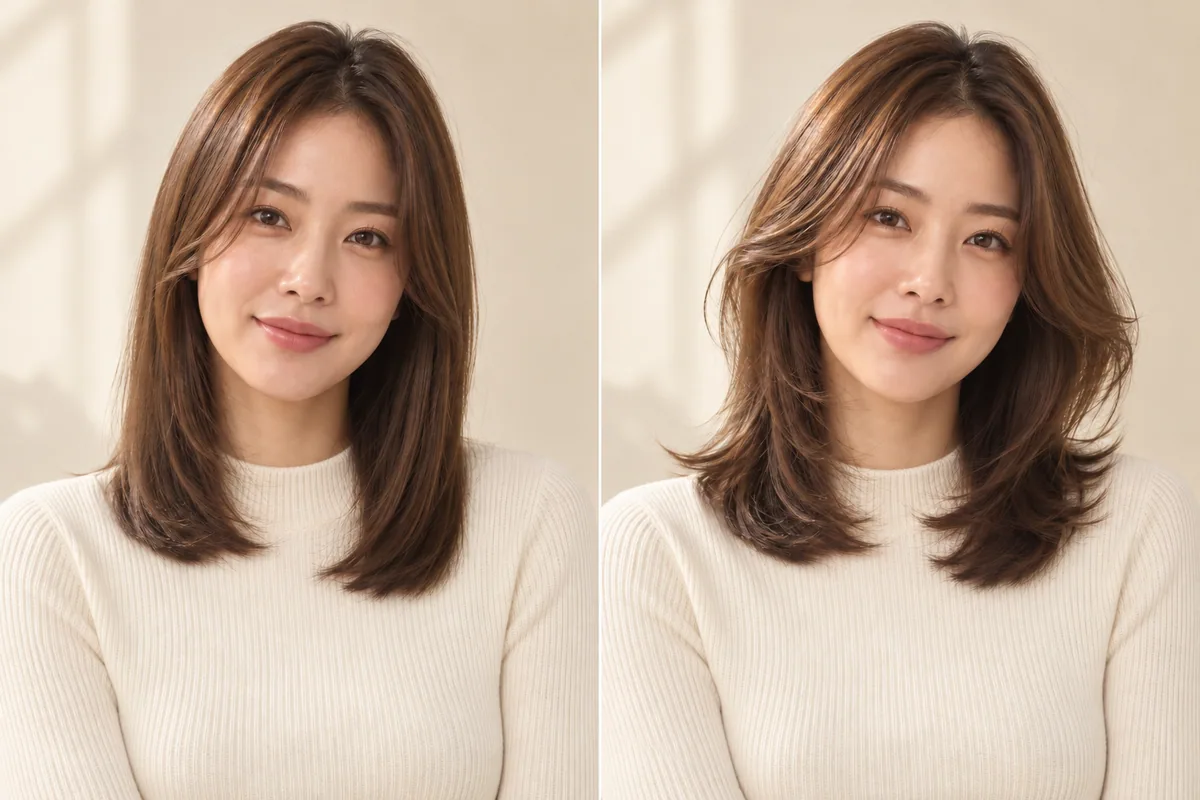
A butterfly haircut can work on straight hair, but cutting layers will not make a round-brush blowout appear by itself. The shorter front pieces and longer lower lengths belong to the haircut. The sweeping bends, lifted roots and turned-out ends in many references may depend on styling. Choose the cut only after deciding whether you also like a quieter version of that shape.
That distinction matters if your main question is whether a butterfly haircut will work without heat. You can ask for a layered shape to wear in your usual finish. You cannot assume it will air-dry into the same arrangement as a styled photograph.
What would remain if you took away the blowout?
In Hair.com's butterfly haircut guide, stylist Sunnie Brook describes the relationship between shorter upper layers and longer hair below. The page also includes styling examples. Treat those as two parts of the reference: where the sections finish, and how the ends have been arranged.
Look at the shortest front pieces first. Ignore their curve and identify their approximate length. Next, look at the lowest ends. Finally, notice the difference between those points. If you like that relationship even with the hair hanging more simply, you have found something useful to discuss.
If you mainly love the dramatic outward sweep, say that instead. You may be choosing a finish more than a new layer pattern. A stylist can help you understand what is possible with your current cut before you remove length to chase an effect that comes largely from styling.
Our butterfly haircut versus long layers comparison covers the difference in the amount of change. Here, the narrower decision is whether you enjoy the shape in the finish you will wear most days.
Compare three finishes without changing the question
Build a small reference set: one relaxed straight finish, one with a soft bend, and one polished blowout. Ideally, ask a stylist to show the same or a similar cut in more than one finish. If the references show different people, note the other differences instead of treating them as a controlled before-and-after test.
On a small screen, swipe the table to compare every column.
| Reference | What to look at | What it does not establish |
|---|---|---|
| Relaxed or air-dried straight hair | Where the shorter pieces sit when the ends are not deliberately curled | Exactly how your own hair will dry |
| A softly arranged bend | Whether a little shape around the front gives you the effect you enjoy | That the bend will stay without any arranging |
| A full blowout | Which lifted areas and curves attract you | The appearance of an ordinary day without that routine |
Keep the longest length and color reasonably similar across the set. A waist-length brunette and a shoulder-length blonde differ in more than finish. If you are drawn to the shorter outline, our medium-length butterfly haircut guide will help you locate the shortest pieces separately from the overall length.
The illustration on this page makes a visual contrast between a relaxed and a more shaped finish. It is imagined editorial artwork, not a demonstration of one real haircut before and after blow-drying. Use it to name a preference, not to estimate the work your hair will need.
If you want heat-free mornings, describe the morning
“Low maintenance” is too vague to settle this choice. Tell the stylist what you already do after washing, how you arrange the front and whether you are happy to make small adjustments later. A person who enjoys a few minutes of arranging their hair has a different brief from someone who wants to leave it alone once dry.
Bring a current photograph taken on an ordinary day, without preparing your hair specially for the appointment. It gives the stylist a starting point for discussing your texture and growth direction. You do not need your current hair to look polished for that picture to be useful.
Then ask these questions:
- Where would the shortest pieces sit in my normal dry finish?
- Which parts of this reference rely on a brush, rollers or heat styling?
- Could we keep the front longer if I do not want to arrange it every morning?
- Can you show me a simple way to wear the proposed cut on a day when I skip styling?
Ask for that last option to be demonstrated on your own hair where possible. A finished photograph cannot show the sequence or effort behind it. The low-maintenance haircut checklist helps turn a vague promise of “easy” into a routine you can actually evaluate.
Straight hair is not one identical starting point
You may describe your hair as straight but still notice an outward turn at the shoulders, a bend after tucking it behind your ears or front pieces that settle in different directions. Record those observations without deciding what they mean technically. They are useful details for the person assessing your cut.
The lower edge matters too. You might love the top half of a layered reference but prefer a quieter, more continuous-looking outline at the bottom. Ask whether the amount of separation in the picture fits that preference. More visible layers are not automatically a better interpretation of the trend.
Hair.com's feathered-hair explanation discusses feathered appearance alongside layered hair and styling. The practical lesson for your reference folder is to describe the detail you like: separated ends, a soft sweep or shorter front sections. One label does not explain all three.
Two possible decisions from the same inspiration photo
Imagine you love a collarbone-length butterfly reference with curved front pieces. You wear your hair straight most days and want to keep doing so. A useful request would be: “I like where the front pieces finish, but I want to like the cut when the ends are not turned out. Please show me a less styled reference and explain how much of the lower edge would remain.”
Someone else may enjoy a weekly blowout and accept a relaxed finish between washes. Their request could be: “I like the sweep around the cheeks when I style it, and I am comfortable with a straighter version on other days. I would like you to show me which part of the finish I should practice.”
These are hypothetical examples, not client stories. Neither person has to abandon the idea. They simply need a haircut plan that reflects the version they expect to wear.
Use a photo preview to choose the outline
In Hair Magic for iPhone, start with a clear photo and choose the closest available medium or long layered style. Keep your current color. Use length, layers or texture details where the selected style offers them. The catalog may use a different name from your inspiration photo.
Tap Generate after reviewing your choices. Your photo uploads for cloud processing, which requires internet. Compare the result with your original and focus on the placement of the front pieces and the overall length. The photo hairstyle try-on guide walks through the controls and comparison process.
A generated smooth or blowout-like finish is not a simulation of air-drying your real hair. It also cannot estimate how long styling will take you. If a preview has appealing length but much more lift than you want to pursue, keep the length as the useful observation. Our AI preview accuracy guide explains how to read those differences.
Choose one appearance preference and one routine limit for your Salon Card: for example, “movement beside the face” and “no daily blowout.” Hair Magic is free to download with in-app purchases; review preview access in the app before generating. At the salon, put those two notes beside the reference. They explain what you want more clearly than the most polished picture alone.
About this guidance. Published by Hair Magic, the app discussed here. Product details are based on the Hair Magic App Store listing, checked on 18 October 2026. This is planning guidance, not a professional assessment of your hair. AI previews are visual estimates; features and prices may change.
Read our editorial approach or explore all journal articles.