
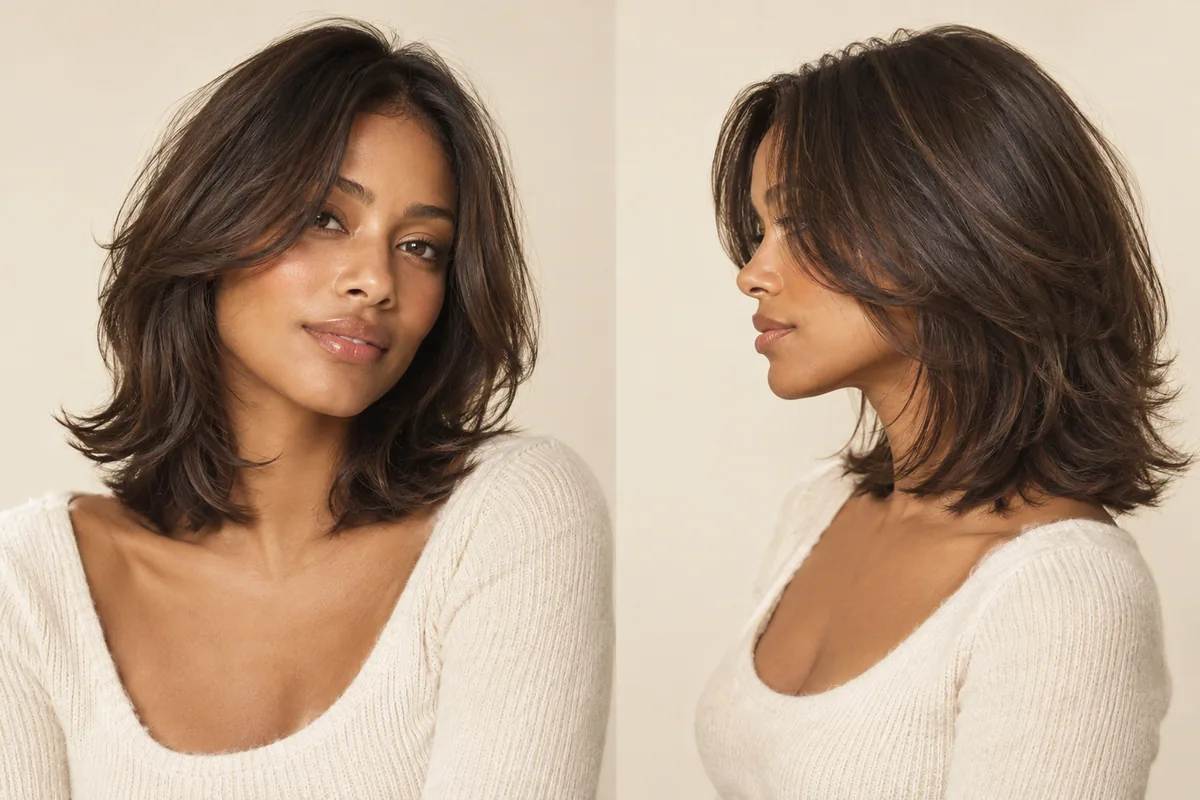
A butterfly haircut on medium-length hair needs two separate decisions: where the longest ends will sit, and how short the layers above them can be. At shoulder or collarbone length, that gap can change the whole feel of the cut. Keep the lower outline in view while choosing the shorter pieces; liking the sweep around someone's face does not mean you want every layer in their reference.
There is no single shortest-layer measurement that works for everyone. The useful answer depends on your current length, your usual texture and whether those front pieces still need to tuck or tie back. Here is how to arrive at an answer you can show your stylist.
Start with three landmarks on your own hair
“Medium length” might mean just touching the shoulders to you and sitting below the collarbone to someone else. Take a current front photo with your head level and hair in its usual dry state. Mark three things in your phone's photo editor or on a printed copy:
- The lowest point you want the finished outline to reach.
- The shortest front piece you would feel comfortable wearing.
- The section that must still reach behind your ear or into your usual tie.
These marks are preferences for a consultation, not a cutting guide. They reveal whether the references you like fit the length you actually want to keep. If a photo's front pieces end near the cheek while your minimum is below the chin, circle the sweeping finish you like and cross out the shorter starting point.
In Hair.com's butterfly haircut explanation, stylist Sunnie Brook describes shorter upper layers combined with longer lengths beneath. That relationship explains the appeal. Her example gives a particular placement; it should not become a universal measurement for your head or your cut.
How much separation do you want between the layers?
Look at your reference with the bottom half covered. Would you still enjoy the shorter shape you see? Then uncover it and check the ends. Both parts should appeal to you, because “keeping the length” at the bottom does not preserve the feel of longer hair everywhere else.
For a first consultation, compare two clearly different options: restrained front framing and a stronger separation between the upper and lower lengths. Do not start with ten versions of almost the same blowout. If you are still deciding whether you want much layering at all, the butterfly haircut versus long layers comparison covers that broader choice.
Use this table to identify what needs closer attention. It is a set of questions, not a rule that assigns a haircut to a hair type.
On a small screen, swipe the table to compare every column.
| What you notice about your hair | What to examine in the reference | A useful question for the stylist |
|---|---|---|
| You like a substantial-looking bottom edge | How much hair remains near the longest ends | “Can we keep this outline while adding movement mostly at the front?” |
| Hair feels heavy around the sides | Where the shape is wide, rather than just how many layers it has | “Which area would you change, and what would stay long?” |
| You wear waves or curls most days | The dry position of the shortest pieces | “Where would these sections sit in my usual texture?” |
| You usually wear your hair straight | Whether you like the layer placement without turned-out ends | “Can you show me a similar cut with a quieter finish?” |
| You rely on a ponytail or clip | The front sections that travel to the fastening point | “Which pieces would stop reaching this if we chose that length?” |
Fine strands and low density are different things, so say what you observe instead of assuming the label explains everything. Our haircuts for fine hair guide can help you describe your priorities without asking a haircut to create more actual hair.
A shoulder-length outline leaves less room to hide a compromise
Imagine two inspiration photos. Both finish at the collarbone. In one, most of the visible change sits near the ends; in the other, a shorter upper shape is easy to distinguish. The shared longest length does not make them equally subtle.
Now imagine choosing the second reference but moving its whole outline up to your shoulders. You have changed the relationship between the lengths as well as the overall length. Ask the stylist to assess that combination, rather than assuming a long butterfly reference can simply be shortened all over.
The same applies when growing an existing bob. You may prefer to keep the current perimeter while discussing gentle front shaping, then reconsider the stronger layered idea when there is more length to work with. That is a reasonable haircut plan in its own right; you do not need to reproduce a trend photograph at this appointment.
Test the hair-up requirement before discussing bangs
Bring your usual clip or tie and demonstrate where you wear it. Gather your hair the way you do on a busy morning, without pulling it unusually tight to make it reach. Let your stylist see which shorter sections already escape.
Be precise about what counts as success. “A low ponytail with two loose pieces is fine” gives a different brief from “I need all the front hair secured for work.” Adding a fringe is another decision again. The soft front sweep in a butterfly reference may contain shorter pieces you would not want around your face all day.
If tying back is essential, work through the short hair and ponytail worksheet before choosing the shortest layers. A convincing hair-down image cannot settle that practical question.
Two worked salon briefs
These examples are fictional planning situations, not client results.
Collarbone length, fuller-looking ends, occasional styling. You like the front sweep but usually leave the rest alone. Your request could be: “Keep the lower outline around my collarbone. I like this movement beside the face, but I want you to show me the shortest pieces before we agree. The bottom should still look substantial when I wear it straight. I can style the front sometimes; I am not planning a full blowout every morning.”
Shoulder length, natural waves, daily clip. Here the practical requirement comes first: “This is the clip I wear, and these front pieces need to reach it. I like the layered shape in the photo, but please assess it with my waves as they normally sit. If the proposed layers would fall out of the clip, I would rather keep them longer and make a smaller change.”
Notice that neither brief depends on saying the trend name perfectly. Each tells the stylist which part of the picture matters and where there is room to adapt it.
Preview the silhouette, then check the cut in person
In Hair Magic for iPhone, choose a clear photo and browse supported medium or layered styles. Keep your current color while comparing the shape. Look for the shape you like rather than relying on the haircut name, and adjust length or layers where the selected style offers those options.
Review the choices and tap Generate. The photo uploads for cloud processing, so an internet connection is needed. Compare the preview with the original and ask one focused question: do you enjoy more movement near the face at this overall length? The photo try-on guide explains the full workflow.
An AI image cannot assess the density left at your ends, predict your wave pattern or prove that a layer will reach your clip. Add those questions to your Salon Card and take the separate landmark photo to your appointment. Downloading the app is free; check the in-app preview access and purchase terms before generating.
Before cutting begins, ask to see the proposed shortest front piece and longest finished length together. Those two points are the decision. The name on the reference is only a starting point.
About this guidance. Published by Hair Magic, the app discussed here. Product details are based on the Hair Magic App Store listing, checked on 1 October 2026. This is planning guidance, not a professional assessment of your hair. AI previews are visual estimates; features and prices may change.
Read our editorial approach or explore all journal articles.