
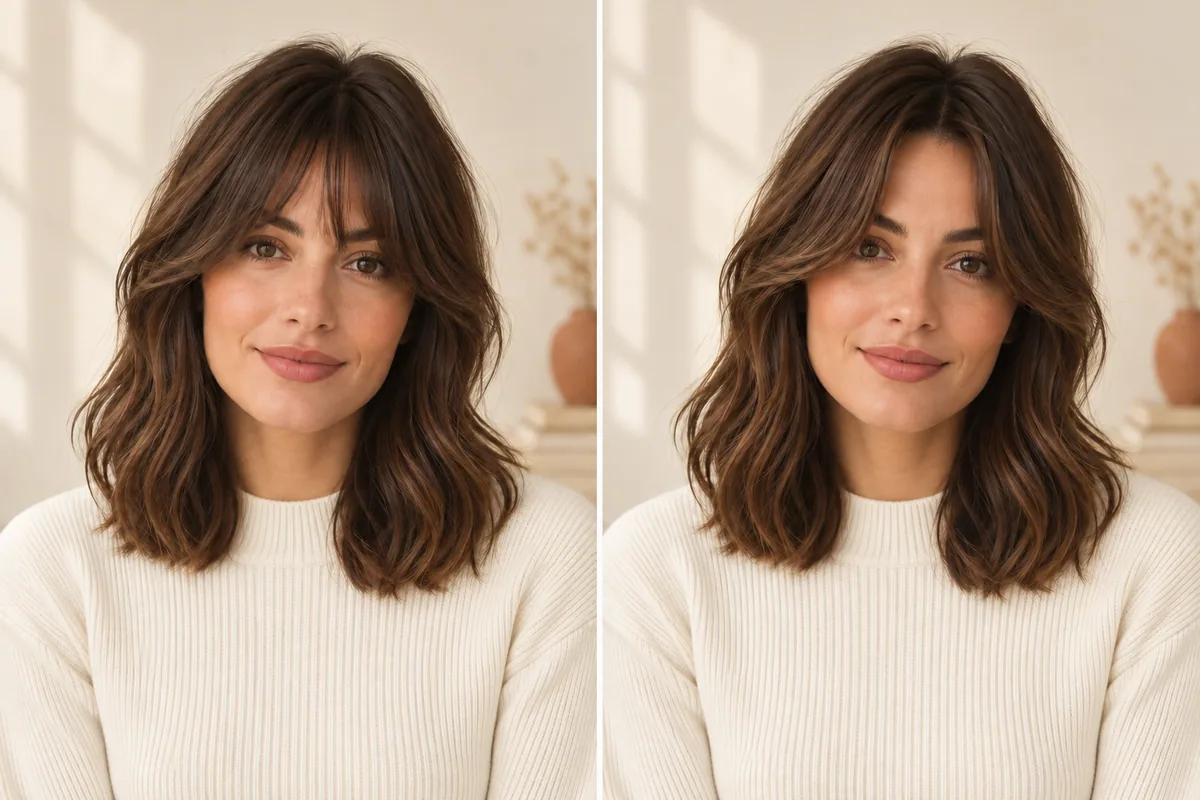
Bottleneck bangs usually have a shorter, narrower section in the middle that extends into longer pieces at the sides. Curtain bangs tend to emphasize an opening, with the fringe moving away from the center. Both can frame the cheeks, and salon usage overlaps. The most useful difference to check is whether you want shorter hair across the middle of your forehead or a more open front.
You might like the same long side pieces in both pictures. That does not mean the choice is trivial: the short center is the part you will see and feel every day. Decide on that section before being distracted by the rest of the haircut.
Start with the center, then follow the sides
Hair.com's professional guide to the bottleneck bob, featuring hairstylist Clariss Rubenstein, describes the fringe as narrow and short at the middle, widening toward the cheeks and temples. That description applies to the front shape; choosing it does not require getting a bob.
For the other reference, Sam Villa's curtain-bangs demonstration describes a parted front with progressively longer sides. Think of these as useful examples of the terms, rather than measurements every salon follows.
Look at the generated illustration above, then at your own saved references. In each image, identify the opening, the shortest visible ends and the longer edges. You can compare those features even if one caption says bottleneck fringe and another says long curtain bangs. The illustration is a visual explanation, not proof of a particular cut or its styling requirements.
On a small screen, swipe the table to compare every column.
| Detail | Bottleneck-style reference | Curtain-style reference |
|---|---|---|
| Middle of the forehead | A short central section is part of the look | An opening usually plays a larger role |
| Transition toward the sides | Shorter middle pieces lead into longer edges | The two sides frame the opening and become longer |
| Main decision | How short and how present the center should be | How open the center should feel |
| Detail the label leaves unresolved | Thickness, exact length and daily finish | Thickness, exact length and daily finish |
A lighter fringe is a separate choice
Do you prefer bottleneck bangs, or do you prefer that one photograph happens to show less hair? Those are not necessarily the same decision.
Imagine the two outlines drawn with a pen. First compare the line where the ends stop. Then compare how much of the forehead is visible between the strands. A shorter center can look light or quite full. An open curtain shape can have substantial side sections while showing plenty of forehead in the middle.
This distinction prevents an unclear salon request such as “bottleneck, but very light” from becoming your whole brief. Point to the coverage you want. If you like the outline of one reference and the separation in another, explain that you are combining two details.
Our curtain bangs versus wispy bangs article focuses on this difference between opening and lightness. The French bangs versus wispy bangs comparison also shows why a soft fringe can fit more than one trend label.
Use your eyebrows as a reference, not a cutting guide
You can point near your brows to show where you would enjoy the shortest pieces. You are describing the intended dry appearance, not telling the stylist where to place the scissors.
That matters if your inspiration has a round, lifted finish. The ends may appear higher because of the way the hair has been arranged. Bring a second picture with a finish closer to the one you normally wear, or ask the stylist what would change without the bend.
Try saying: “I like that little section in the middle, but I want it clear of my eyes when I leave it alone.” Alternatively: “I like these side pieces, but I want the center mostly open.” Neither statement depends on a face-shape rule. They describe how you want to see and wear your hair.
If you already have a fringe, take a quick photo of the current length before the appointment. Mark what is comfortable and what you keep moving away. Your own familiar reference can be more useful than another highly styled inspiration picture.
Check the shape with glasses and hair tied back
Put on your usual glasses when comparing the two options. Consider the middle and the temples separately. You may enjoy a little hair above the frames while wanting the side pieces clear of the hinges, or prefer a wide opening that leaves the upper rim visible.
There is no need to reject either style because you wear glasses. Show the stylist how you put the frames on and which bits of hair tend to catch. The hairstyles with glasses guide has a fuller checklist for the frame area.
Now consider a ponytail. A short central section will remain part of the face-framing appearance when the longer hair is pulled back. If you want every piece secured for work, demonstrate that requirement. Long overall hair does not guarantee that newly cut front pieces will reach the tie.
If what you really want is movement beside your cheeks without a shorter center, compare bangs and longer face-framing layers. You may find that you like the side connection in a bottleneck reference more than you like the fringe itself.
Decide how you want the fringe to age between trims
A short center creates a separate length to maintain. Ask what the proposed shape will look like as that section gets longer. Will you keep returning it to the same point, or would you be happy for the opening to change?
Avoid choosing a haircut from a universal appointment interval. You may like a precise brow-level line while someone else enjoys letting the same starting cut become longer and looser. Ask the stylist which change you are likely to notice first, and what would prompt you to book a trim.
Also ask about a future change of mind. If you decide to stop maintaining the middle, what is the intended next shape? Our guide to growing out bangs can help you describe that preference without expecting an overnight transition.
Keep daily arranging separate from salon visits. A fringe you are happy to trim regularly may still need more morning attention than you want. Ask for a demonstration of the finish in your reference and a description of the less styled version.
Preview the appearance without changing everything else
For this decision, Hair Magic is most useful when the front stays the focus. Take or select a clear photo on your iPhone and browse the available bangs styles. Choose a close visual direction, then check which details that hairstyle supports. Use the nearest available shape rather than expecting every trend name or an exact fringe-density control.
Keep the current color and choose similar overall lengths where possible. If one preview also adds much more volume or changes the texture, do not credit the entire difference to the fringe. Look specifically at the opening and the shortest pieces.
Tap Generate when you are ready to preview the choice. Your photo is uploaded for cloud processing, which requires internet access. Compare the result with your original and save or share a useful image if you want to bring it to the salon. The bangs preview guide explains the process. Hair Magic is free to download with in-app purchases; check generation access in the app.
A convincing image cannot tell you whether the center will separate naturally or how much hair a stylist should include. It can help you say, “I like this amount of coverage, but I want the middle longer.” Take that preference into a consultation rather than asking for an exact copy of the generated strands.
Make one clear request about the middle
Before choosing a name, finish this sentence: “I want the middle of my fringe to ______.” Examples include stay open, cover part of my forehead, sit above my frames, or remain long enough to move aside.
Then add one sentence about the sides: “I want these pieces to connect gradually toward my jaw,” or “I want to keep this much length near my ears.” Keep the notes with your reference or Salon Card.
At the appointment, ask the stylist to show the proposed shortest section before cutting. If you agree on that point and on how the sides connect, you have resolved the important part of bottleneck bangs versus curtain bangs.
About this guidance. Published by Hair Magic, the app discussed here. Product details are based on the Hair Magic App Store listing, checked on 18 October 2026. This is planning guidance, not a professional assessment of your hair. AI previews are visual estimates; features and prices may change.
Read our editorial approach or explore all journal articles.